The Forma Urbis: why a marble map changes how you see Rome
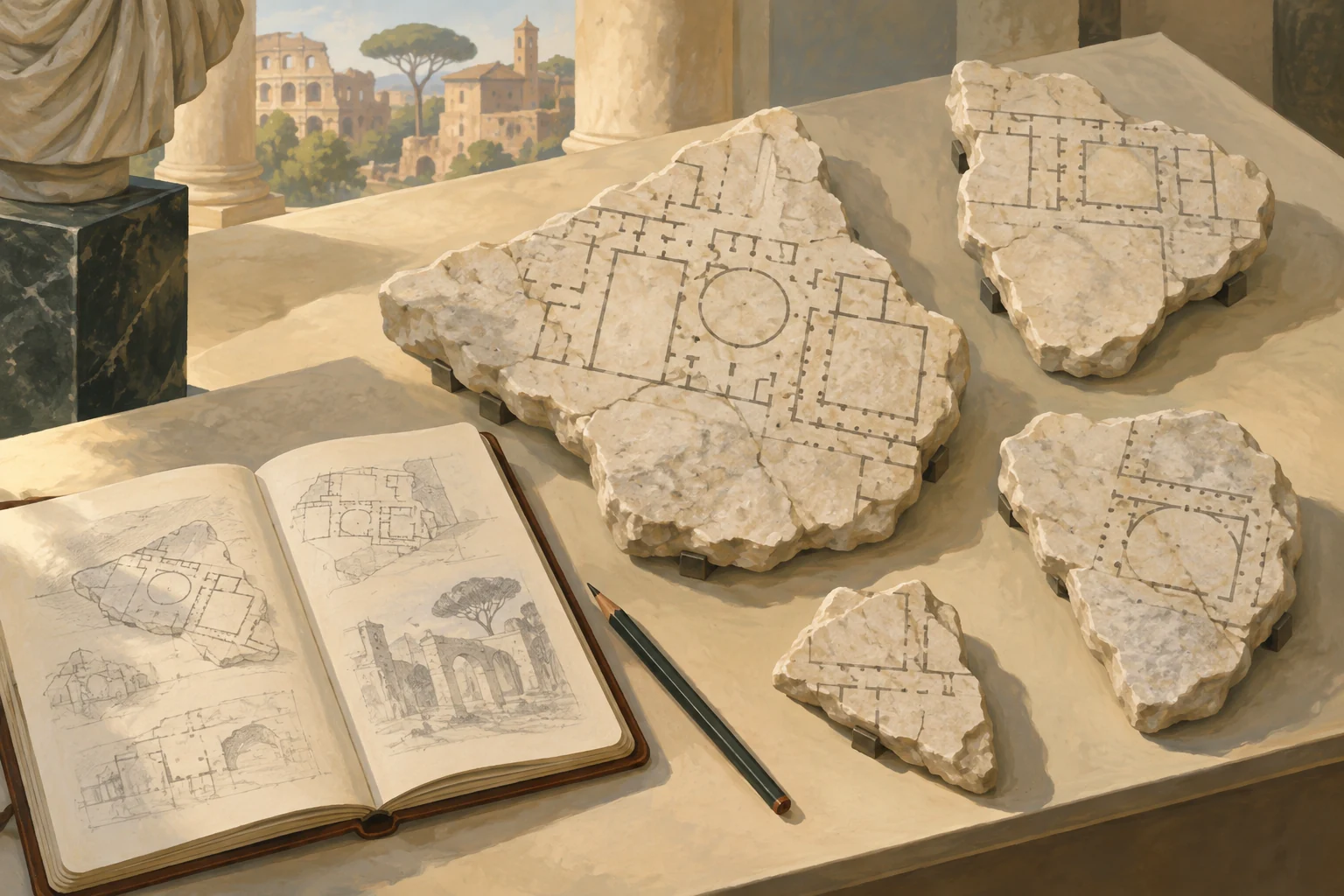
A marble map asks you to explore Rome with a different set of muscles: less walking, more looking. At the Museo della Forma Urbis on the Celio, fragments of an ancient city plan turn walls, courtyards and streets into delicate lines. The point is not to recognize everything. It is to discover how a city changes when you see it as a set of relationships, and how much care is needed when most of the original evidence is missing.
The museum can be the main intellectual focus of an otherwise gentle outing. Our Celio walking guide places it in its neighborhood. Choose the museum deliberately rather than attaching it to an already full Forum day simply because the names sit close together on a modern map.
Start with the difference between a fragment and a miniature city
The municipal heritage authority’s museum description dates the monumental plan to 203–211 CE. It was engraved on marble slabs and displayed on a wall in the Temple of Peace complex. Its average scale was approximately 1:240. Only about a tenth survives, and not every fragment can be securely placed in the modern city.
Those facts suggest a rewarding first question: what does a particular piece actually preserve? A corner, a sequence of rooms or a curving outline may be visible; the lost part beyond a broken edge is not. Resist completing it mentally before reading the interpretation. A fragment does not become less interesting because its identity remains uncertain. It can still show how a maker represented space.
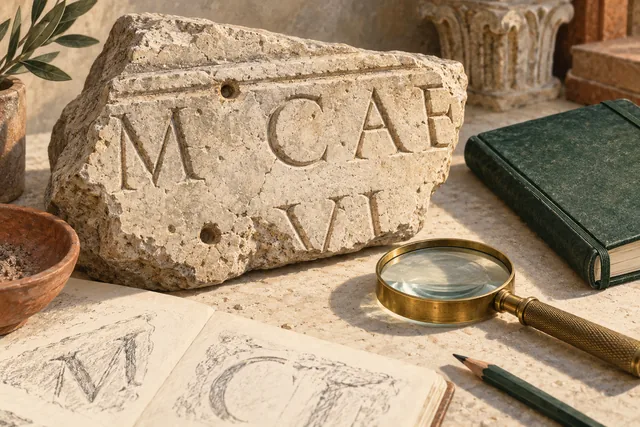
Choose a piece with an easily visible pattern. Count repeated shapes, follow one line and notice where it stops at a break. Then read the museum label. Our guide to reading Roman inscriptions uses a similar distinction between what an object shows and what its interpretation supplies. The order matters: observation gives you a question for the explanation to answer. You are building a small understanding of evidence rather than collecting another recognized monument.
Two maps in one display do not mean two ancient maps
Turismo Roma’s account of the display explains that the fragments are placed above Giovanni Battista Nolli’s 1748 plan. The later map helps viewers locate and compare surviving pieces. It is an interpretive background, separated from the ancient marble by many centuries. Keeping those dates distinct is essential to understanding what the exhibition is doing.
Try a simple comparison. Follow an ancient engraved line first, then look at the different graphic language underneath. Which information belongs to which layer? Where does the display help you orient yourself, and where does the fragment still leave a gap? You do not need to solve the city to appreciate the method. In fact, noticing the gaps is part of reading the exhibition well.
Ask what a map leaves out
A plan can communicate arrangements very efficiently, but it does not give you the experience of moving through a doorway or standing below a high wall. Think back to a place you have already visited. Could your memory of its height, sound or changing light be captured by a floor plan? Which features would disappear, even in an accurate drawing?
Our Roman Forum introduction approaches buildings from ground level. Put that experience beside the map rather than treating one as the superior way of seeing. A plan can make a relationship clear that was confusing on foot; a walk can make the scale of a mapped line suddenly meaningful. Neither needs to tell the whole story alone.
A sketchbook makes a useful companion. Draw one simple arrangement from memory after leaving the display, then write down what you were unsure about. Keep your sketch explicitly personal; it is a record of attention, not archaeological documentation. This is also a satisfying activity for travelers who enjoy museums but tire of long sequences of dates and names.
Make admission and the surrounding walk separate decisions
Use the heritage authority’s current visitor information for museum admission, opening days and access arrangements. Do not assume a Colosseum ticket includes this municipal museum, or that entry to the surrounding archaeological park means every interior is open. If a tour interests you, compare its named stops with the history experience collection; inclusion should be explicit.
Finish with a place where you can look back at the city rather than hurrying to another collection. For a different kind of object-centered afternoon on another day, Rome Tour Hub’s Capitoline Museums introduction offers a useful comparison. The Forma Urbis leaves you with a portable habit: ask what survives, identify how it is being explained, and enjoy the space between a confident answer and a good new question.
Sources & further reading
Turn a good read into a great day.
Find a highly rated Roman experience that brings these stories to life.
Explore related experiences →