Rome’s Sette Sale: why did Trajan’s baths need a reservoir on two levels?

If you went looking for seven rooms under the hill above the Colosseum, you would have a lovely old name and the wrong answer. The Sette Sale cistern has nine parallel spaces on each of two levels. The upper chambers supplied water to Trajan's baths. Their supporting storey raised the supply above its destination. The machinery of a Roman bathing day began out of sight, with the difference in height between a reservoir and the people who wanted their water elsewhere.
Draw the waterline first
Start with an empty glass held above a basin. If you poured the water through a tube from that height, gravity would do the work. Now imagine both ends at precisely the same level. The thought experiment is deliberately crude, but it makes the lower storey of the Sette Sale intelligible. It took considerable building to put nothing so useful as a height difference under the tank. The municipal archaeological description distinguishes the supporting level from the upper reservoir. Simply counting all the vaults as containers would double the wrong thing.
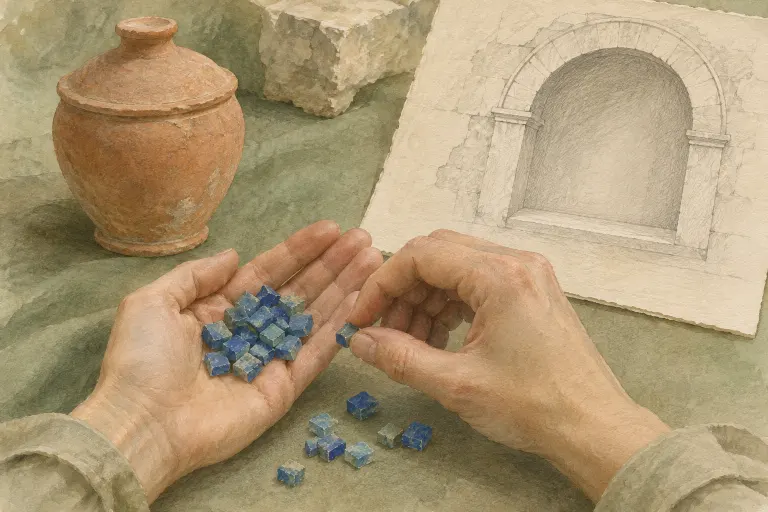
On paper, draw a line for the water in the upper storey. Mark the baths somewhere lower on the page and a supply arriving from the Esquiline. You now have the beginning, middle and end of the system without drawing a single handsome Roman arch. The baths could call on a reserve downstream of the incoming supply. That is a different job from carrying water across a road, a distinction you can pursue at Porta Maggiore, where the overhead channels are easier to relate to a traveller passing underneath.
Follow the sideways openings
The tank is much more interesting than a single oversized bathtub. Parallel rooms of unequal length follow the curved boundary on one side. Openings in the dividing walls allowed water to pass between chambers. Their arrangement on diagonal axes mattered to circulation. A straight photograph through an arch can make the whole building look as though a visitor ought to be able to walk an unobstructed line from end to end. A plan gives a more accurate impression of how water moved through connected spaces. Trace two possible paths with your finger and notice where a solid wall interrupts the seemingly obvious route.
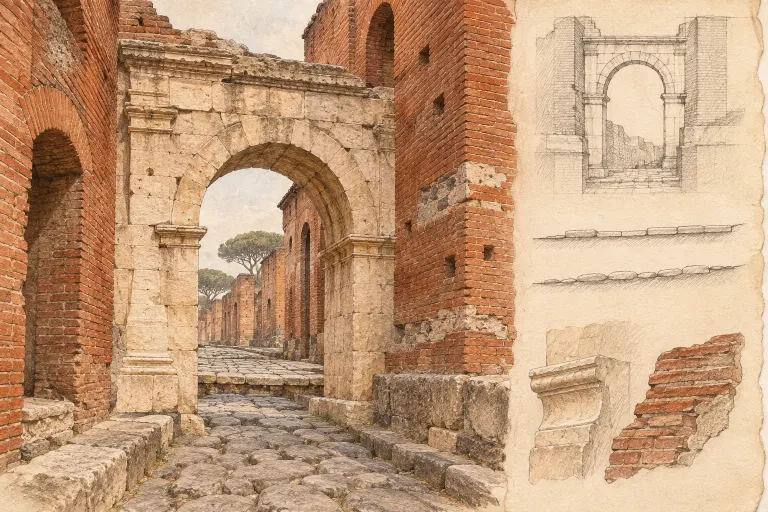
The city's photographs also help distinguish surfaces that held water from the masonry that supported them. Hydraulic plaster lined the floor and walls of the reservoir. It was a functional finish. A wet wall has a different job from a bath hall wall hung with marble, however impressive both spaces look to a visitor. In a Roman materials notebook, give finishes a column of their own beside the core of a wall. That way a coating that made storage possible receives as much attention as the more photogenic vault over it.
A puzzle solved with a brick
The cistern and the great bath complex do not point in quite the same direction. For a time that discrepancy supported the idea that the tank belonged to Nero's palace. It is an attractive inference. There is a grand earlier structure nearby, and the two later structures seem to disagree about their alignment. The dates of stamped bricks in the reservoir's fabric give the city archaeologists a better reason to associate it with Trajan's building campaign. If you want an example of why brick stamps matter beyond a collector's catalogue, here is one capable of moving an enormous building from one historical story into another.
Think about the alternative evidence you might have wanted. Two buildings with matching axes can belong to different periods if both follow an old road. Two contemporary builders can turn a wall to fit the available slope. Orientation is a good question to ask of a plan. It makes a rather poor birth certificate. Comparing the stamps with the orientation is more rewarding than memorising a corrected imperial name.
Use the city monument page and its published photographs to plan your study. Check separately for access before making a walk depend on admission to the interior. A visit to the nearby bath landscape or one of the archaeological history itineraries need not include the cistern chambers. On the hill outside, give somebody else the sketch and ask which way the water should travel. The answer will tell you whether your nine nearly identical rooms have turned into a working building.
Sources & further reading
Turn a good read into a great day.
Find a highly rated Roman experience that brings these stories to life.
Explore related experiences →