Rome’s Porta Maggiore: why was this city gate first an aqueduct?

At Porta Maggiore, the easiest assumption is also the one worth questioning: surely a large opening in a city wall was built as a gate. Here the monumental arches came first as part of a water-supply system. Their later incorporation into Rome’s defences gave them another job. Looking at the structure as infrastructure before fortification turns a familiar-looking monument into evidence of a city adapting what it already had.
Begin above the opening
Turismo Roma dates the monumental crossing to AD 52, under Claudius. It carried the Aqua Claudia and Anio Novus across the routes towards Praeneste and Labici. The water travelled in conduits above the road openings, not through the great arches themselves. That distinction sounds obvious once stated, but it changes where you look: the substantial upper structure is part of the engineering story.
The municipal account of the aqueducts describes their long approach from the Aniene valley, maintaining the gradient needed to bring water towards Rome. Near the city, the two channels shared a supporting structure, with the Anio Novus above the Claudia. The impressive stonework at Porta Maggiore therefore belonged to systems extending far beyond the visible junction. A short stop can reveal only one part of that larger network.
Ask why a crossing could also be a statement
An aqueduct has a practical task, but its crossing of important roads offers an opportunity for public display. At Porta Maggiore, heavy masonry and architectural framing give that crossing a monumental presence. You can consider how utility and appearance work together without having to choose between calling the structure functional or decorative. The same building can do useful work and advertise that work.
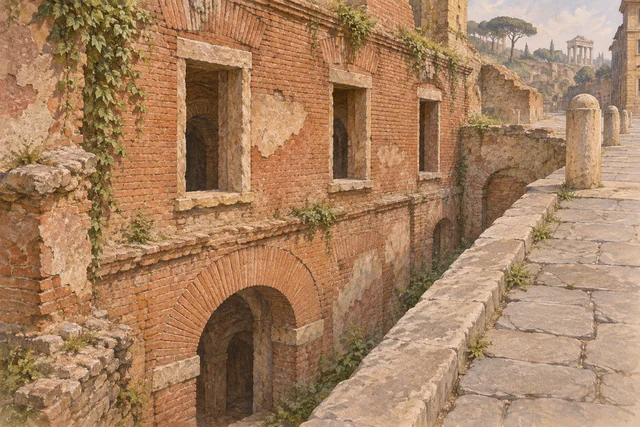
Look first at the contrast between solid mass and open space. Then notice how the smaller architectural elements relate to the main arches. Describe their arrangement before trying to label every style. This is a good exercise for anyone who finds archaeological terminology intimidating: a careful observation about proportion is more useful than an architectural name attached with confidence to the wrong feature.
Add the walls as a later chapter
The national tourism account places the conversion into a city gateway within the building of Aurelian’s defensive circuit in the later third century. The municipal virtual museum of Rome’s walls explains how the aqueduct arches were absorbed into that new boundary. A structure designed to carry water over roads became part of a system intended to control passage into the city.
That change should not be imagined as a single neat addition preserved untouched ever since. The walls museum describes towers, alterations under Honorius and nineteenth-century demolitions. Historical images help document elements that no longer stand. When a modern photograph seems simpler than an old engraving, the difference may record removal rather than an earlier artist’s invention. Compare the date and purpose of each image before deciding.
Read inscriptions as evidence of maintenance
The surviving inscriptions include records associated with Claudius and with repairs under Vespasian and Titus. They remind us that public infrastructure needed continued intervention. A monument’s completion date is not the end of its history. Maintaining a water supply could be something worth recording conspicuously, with later rulers attaching their names to the work.
You do not have to translate every line while standing at a road junction. Identify where the inscriptions sit, then consult a reliable transcription in a safer, quieter setting. Our guide to Roman inscriptions explains how to approach abbreviated texts. Distinguish a readable letter from a confident guess, especially when distance and weathering make the stone difficult to examine.
Treat the junction as a working part of Rome
Porta Maggiore remains surrounded by transport infrastructure and traffic. Use designated pedestrian crossings, keep clear of tracks and roadways, and choose a safe public viewpoint. Do not back into the street to fit both arches into a photograph. The modern setting can make close looking less tranquil than a museum visit, so a brief, deliberate stop is often more rewarding than attempting a prolonged examination.
The nearby tomb of Eurysaces adds a distinct funerary story, while our Roman building-materials article offers a vocabulary for examining surfaces. The underground basilica is a separate monument with separate access arrangements; an exterior walk does not include entry beneath the area.
Compare Rome archaeological walks by their actual route and meeting point. Rome Tour Hub’s Museo delle Mura guide provides a different setting for exploring the defensive circuit. At Porta Maggiore, keep three verbs in mind: carry, cross and defend. Each points to a different way this piece of architecture has served the city.
Sources & further reading
Turn a good read into a great day.
Find a highly rated Roman experience that brings these stories to life.
Explore related experiences →