Roman bronze mirrors: what changes when a reflection becomes an archaeological object?

A Roman metal mirror can be surprisingly difficult to recognise in a museum case. We expect a mirror to return an image immediately; an archaeological example may offer a dark surface, a decorated reverse or only a surviving lid. That gap between present appearance and former use is precisely what makes the object interesting. Instead of asking only what someone once saw in it, begin with a more answerable question: which part are you looking at, and what does the catalogue actually identify?
Separate the reflecting face from the rest
A useful comparison comes from London Museum’s record of a Roman mirror lid. The copper-alloy object has concentric decoration and protected the reflective surface. The museum explains that many Roman mirrors were made of bronze or silver, with metal surfaces polished to reflect. A lid can therefore tell us about protection and handling even when it is not itself the part that produced the image. Do not label every round piece of metal a complete mirror.
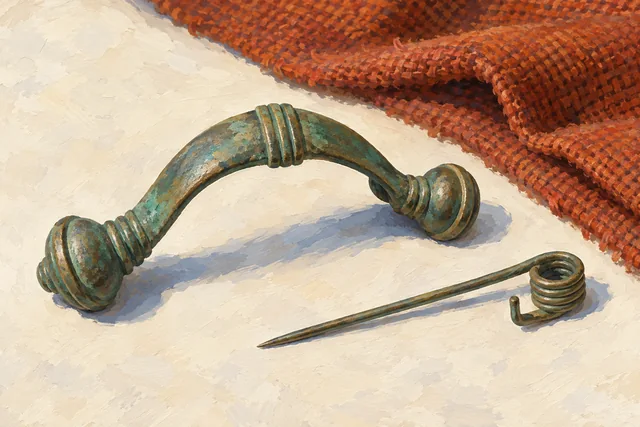
Start with the catalogue’s object name, material and measurements. Then compare those with the photograph or displayed object. Does the label describe a lid, a disc, a handle or an assembled piece? Can you see where components meet? This method also helps with Roman fibulae, where a fastening mechanism may matter more than the decorative outline. Small objects reward the same attention to structure that we readily give to a large building.
Decoration and use are different kinds of evidence
The Metropolitan Museum of Art’s Roman bronze mirror with traces of gilding, object 1978.11.4, provides another case. Its catalogue dates it to the middle of the second century CE, records a diameter of 14.7 centimetres, and identifies a mythological scene of Europa and the bull. The bull represents Zeus, or Jupiter, in disguise. Those details belong to this recorded object; they should not become a description of every Roman mirror.
Look at the reverse and reflecting face as two connected but different design problems. One could carry a scene for someone to contemplate; the other needed to work as a surface. A decorated object invites questions about taste and presentation, yet it does not supply a biography of its owner. Avoid assigning a gender, occupation, household or daily ritual unless the archaeological context or associated evidence supports it. A compelling story is still a hypothesis when the object cannot establish it.
Try describing the mirror without a social label first: its dimensions, material, surviving parts and depicted subject. Only then ask what further evidence would be needed to connect it with a person. The exercise is useful precisely because it leaves some questions unanswered. Our guide to Roman oil lamps similarly separates an object’s decoration from the wider history of how it was used.
Present condition is not a picture of ancient life
A museum photograph records an object after a long history of survival, discovery and care. It is not a photograph of that object in an ancient room. Do not assume that a dull surface was equally dull when used, or that every bright area is untouched ancient finishing. If condition, coatings or restoration are important to your question, look for the museum’s technical record or ask whether further documentation is available. The visible surface alone cannot answer every material question.
Nor should a visitor try to recreate the reflection by touching, rubbing or shining a device directly against a display case. Use the permitted viewpoint and available images. If you are sketching, a simple outline with separate notes for surface and decoration can be more useful than an elaborate invented reflection. The point is to record what the evidence permits, not to make the object perform for us.
Use mirrors to change the scale of a Rome visit
These examples are held in London and New York; they are comparative research material, not a promise that you will find the same objects on a Colosseum route. Their value for a Rome trip is methodological. After looking at monumental architecture, it can be refreshing to ask how a small object fits a hand, requires maintenance or combines ornament with a task. Roman strigils and bathing offer another way into that smaller scale without assuming that one surviving object represents everyone’s experience.
For planning, compare the stated routes in our history experience collection and check which museums or archaeological areas are actually included. The wider city’s collections belong in Rome Tour Hub’s art and museum coverage, where questions about collectors and display add another layer. Leave yourself time to read a label twice. On the first reading, you learn what the object is called. On the second, you often discover how much more carefully the museum has defined its claims than your first glance allowed.
Sources & further reading
Turn a good read into a great day.
Find a highly rated Roman experience that brings these stories to life.
Explore related experiences →