How do you make sense of the Roman Forum?
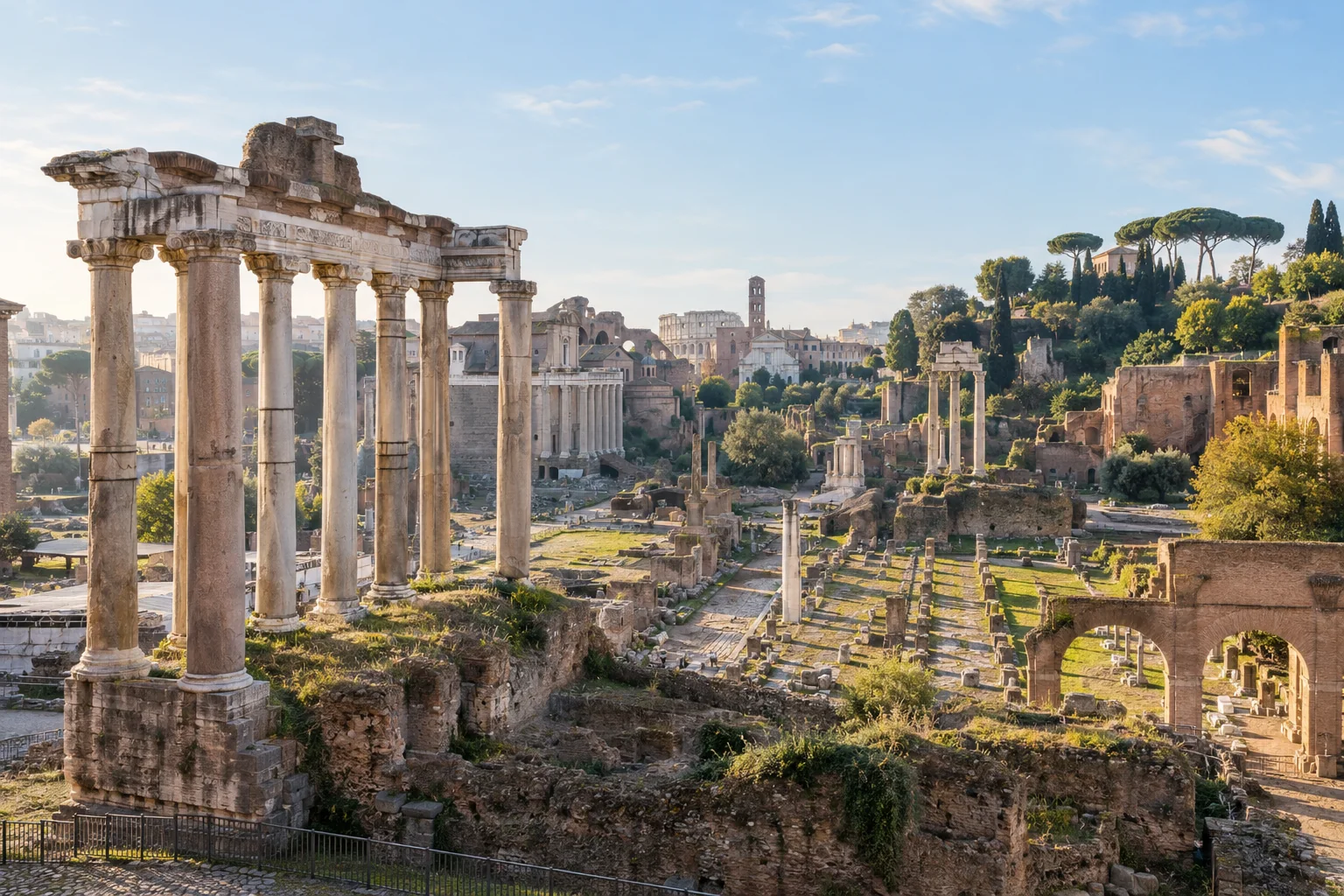
The Roman Forum can be bewildering at first: a beautiful field of fragments, impressive columns, and labels that seem to assume you already know everyone involved. The solution is to stop trying to identify everything. Begin with what the place did. Imagine a civic centre where movement, public business, worship, and political display overlapped, then use a few structures to make that idea concrete.
You do not need to reconstruct the whole city in your head. A useful first visit gives you a sense of the space and a small set of meaningful examples. Five places understood are more satisfying than twenty names collected. Give yourself permission to leave certain questions open; an archaeological site is not an exam paper.
Establish the ground before the buildings
Find a place where you can safely pause without blocking the route. Look along the valley and notice its enclosing slopes. The park's Forum history explains that the area was once marshy and began to take shape after reclamation in the late seventh century BCE. That is the beginning of a useful story about people making usable civic space.
Then trace an obvious line of movement with your eyes. Ask how a person would arrive, where attention would be drawn, and what might interrupt the view. You are not claiming that today's visitor path exactly reproduces ancient experience. You are learning to notice relationships rather than treating each column as a freestanding object with its own isolated date.
Learn a few building types
The word “basilica” can confuse visitors who associate it only with churches. The park describes civil basilicas in the Forum as places used for judicial activity. A temple, an arch, and a large civic hall answer different needs. Learning those broad functions makes the site much easier to read than memorizing a long sequence of architectural names.
Choose one example of each type that is visible on your current route and read the onsite interpretation. What survives: a plan, a façade, a raised platform, a roofed volume, or a few supports? Different kinds of survival ask different things of the imagination. A footprint may require more explanation than a tall ruin, yet tell an equally valuable story.
Look for accumulated time
The Forum developed over centuries. Avoid picturing every surviving feature as part of a single scene frozen on one afternoon. A practical question for a guide is, “Would these two buildings have looked like this at the same time?” Even when the answer is complicated, you gain a better understanding of how a living city changes.
Materials and connections can also prompt questions. Notice where one wall meets another or where an opening seems to have changed purpose. Do not diagnose a construction phase from appearance alone; ask, consult the label, or leave it as an observation. The pleasure of archaeology lies partly in learning how careful interpretation grows from small pieces of evidence.
Alternate close looking with wider views
After reading a sign, look up and place the feature back in the landscape. After studying a detail, step back where the route permits. This rhythm prevents the visit from becoming either pure scenery or pure text. A notebook can help: write one sentence about what a building did, and one about what you can actually see.
If your ticket and energy allow a Palatine visit, our Palatine guide explains how the change in elevation adds another perspective. A view from above can clarify a plan, but it should not replace a slower encounter with the ground-level space. The two experiences answer different questions.
Give the visit a comfortable scale
Uneven surfaces, exposed areas, and the sheer amount to absorb can make an ambitious route tiring. Plan pauses and use current park information to check suitable paths. If your main priority is interpretation, a guide can organize the evidence into a coherent story. If you prefer independent looking, choose fewer stops and read about them beforehand.
Continue with our guide to reading an imperial arch, or browse history experiences for a route that fits your interests. Leave the Forum with a question you can answer in your own words: how did this collection of spaces help a city conduct its public life? That answer will stay with you longer than a hurried list of ruins.
Sources & further reading
Turn a good read into a great day.
Find a highly rated Roman experience that brings these stories to life.
Explore related experiences →