Rome’s Temple of Vesta: what does a circular plan tell you about a sacred place?

In the Roman Forum, the Temple of Vesta offers a useful interruption to the expectation that important buildings must be rectangular. Its circular form draws attention to a different organisation of space. Yet the curve alone cannot tell the whole story. What you see is fragmentary, repeatedly altered and partly reassembled. A thoughtful visit begins by allowing those qualifications to make the monument more interesting, rather than wishing them away.
Find the temple within a wider Forum visit, not as an isolated object floating free of its surroundings. Our Roman Forum introduction helps establish the larger setting. When you reach this part of the site, slow down enough to distinguish the temple from the adjacent residential complex. Their histories connect, but a sacred building and a house should not be read as the same kind of space.
Start with the curve you can see
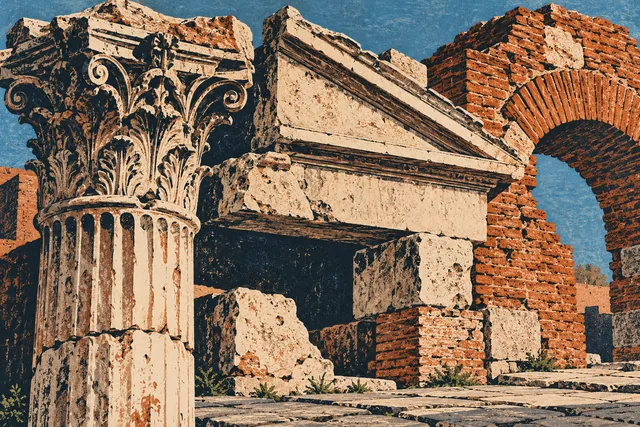
The archaeological park describes a circular podium made from Roman concrete and faced with marble, with Corinthian columns rising above it. Look first for the relationship between the supporting base and the upright elements. The podium gives you a plan at ground level; the columns suggest a vertical rhythm. These are two kinds of information, and you can appreciate them even without mentally filling in the missing structure.
A small sketch can be helpful. Draw only what your chosen viewpoint lets you observe: a line of curve, an upright, an interruption. Resist tidying the drawing into a complete, symmetrical temple. An imperfect record of visible remains can be more honest than a beautiful invention. Our guide to Roman building materials supplies useful vocabulary for separating what a building is made from from how its surface once appeared.
The sacred fire belongs to the interpretation of the place
According to the park’s account, the temple housed the sacred fire associated with the continuity of Rome. The same account presents a possible relationship between the circular form and early huts, using appropriately tentative language. Keep that possibility separate from a demonstrated intention. A rounded plan is visible evidence; a claim about why it was chosen requires historical interpretation. One need not pretend that the first automatically proves the second.
The tradition concerning the Palladium, an image associated with Athena-Minerva and the story of Aeneas, should likewise be understood as a tradition attached to the sanctuary. It is not an invitation to imagine that you can identify its exact former position by looking at a modern photograph. The park’s educational guide discusses uncertainty around the sanctuary’s inner arrangements. Uncertainty is information, not an awkward blank that a visitor must fill.
Rebuilding is part of the monument’s history
The temple experienced repeated fires and rebuilding. The park identifies the visible architectural phase with the Severan period and Julia Domna’s restoration after the late second-century fire. Its educational material also sets out earlier phases. This means that a single founding story cannot explain every surviving piece. When a label names an early tradition and a later structure, both can be relevant without belonging to the same moment.
Modern restoration belongs in the sequence too. The city’s archaeological itinerary explains that the standing reconstructed section incorporates ancient fragments with modern material. Look for interpretation panels that explain that intervention instead of classifying every apparently complete element as untouched antiquity. The useful question is not simply “Is this old?” but “Which parts survive, which support them, and how has the present form been made readable?”
Connect the sanctuary to people without inventing a scene
The neighbouring House of the Vestals helps turn an architectural outline into a question about institutions and daily organisation. Our House of the Vestals article follows that evidence in more detail. You can compare a sanctuary’s concentrated focus with the arrangement of a larger complex, while avoiding a theatrical reconstruction of a particular ceremony that the visible ruins cannot substantiate.
If you want a different circular-building comparison, read our Temple of Hercules Victor guide. Similar geometries do not make two monuments identical in function or history. For the city beyond the archaeological zone, Rome Tour Hub’s Pantheon article asks a different question about enclosing space. These comparisons work best when differences remain as clear as similarities.
Keep access claims as careful as historical ones
Plan the temple as part of the permitted Roman Forum route and check the archaeological park’s current ticket and access information for your visit. Do not assume that proximity to a monument permits climbing onto it, crossing a barrier or entering a restricted area. Our history experience collection can help compare itineraries, but an offer must explicitly state the access it includes. A guide cannot turn an unlisted interior into an entitlement.
Leave with a modest achievement: recognising a curved foundation, understanding why fire matters in the interpretation, and knowing that the current appearance combines several periods of intervention. That is already a strong archaeological reading. The temple becomes more compelling when it remains an investigated, incomplete place rather than a perfectly furnished scene supplied by the imagination.
Sources & further reading
Turn a good read into a great day.
Find a highly rated Roman experience that brings these stories to life.
Explore related experiences →