Rome’s Temple of Hercules Victor: how do you read a circular colonnade?

A circular building changes the way you look. Instead of offering one broad façade and a clearly separate side, its columns continually overlap as your viewpoint shifts. The Temple of Hercules Victor, beside Piazza Bocca della Verità, is an excellent place to notice that effect. You can begin with the exterior and a few patient comparisons. There is no need to turn the visit into a hunt for a secret entrance or to imagine an ancient ceremony in exhaustive detail.
Start by setting aside the wrong name
The monument is sometimes called the Temple of Vesta, but Turismo Roma explicitly identifies that as a mistaken name. Its dedication is to Hercules. A circular plan is a shape, not a reliable label for the deity worshipped inside. This is a small but useful correction to carry around Rome: buildings that resemble one another can have different functions, histories and dedications. Architectural resemblance helps you ask a question; it does not answer every question on its own.
The official description places the temple in the late second century BC and connects it with the wealthy olive-oil merchant Marcus Octavius Herennius. It presents the proposed architect as an attribution rather than an established signature on the building. Keep that distinction. For a first look, the secure relationship between the circular structure and the commercial surroundings is more useful than memorizing a name whose connection remains qualified.
Look at the spaces between columns
From a permitted public viewpoint, compare the columns closest to you with those seen obliquely. The gap between two shafts may appear wide in one position and almost disappear in another. That visual change is yours; the spacing has not moved. If the route permits, take a few steps and repeat the comparison without entering restricted ground. A circular colonnade rewards this small experiment because the eye has to keep revising how the parts line up.
Then look downward. A stepped base mediates between the ground and the standing columns. Ask how the change of level affects the monument’s presence. You can sketch a curve and a few vertical lines rather than attempt an elaborate architectural drawing. The aim is to make your attention more precise, not to pass an art-school examination. Do not climb, lean equipment against the fabric or step over a barrier to improve the composition.
Separate the ancient building from its later life
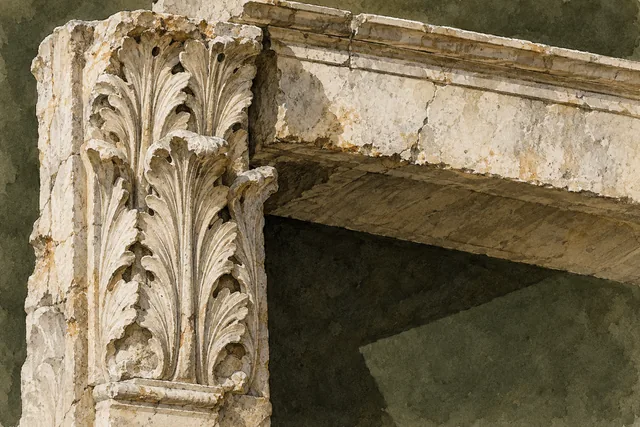
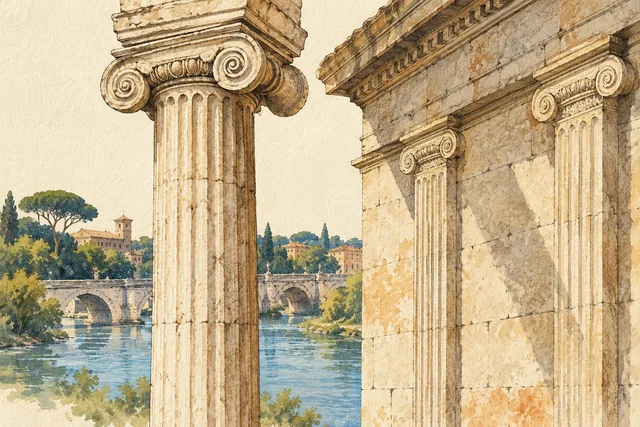
Turismo Roma describes a marble temple with Corinthian columns, later converted to Christian use and subsequently restored. Those phases matter because the visible monument is not an untouched object sealed at the moment of construction. A present roof, an altered opening or a repaired surface may belong to a different chapter from the original design. When a detail puzzles you, consult a documented plan or conservation account instead of supplying a convenient ancient explanation.
The contrast between survival and change is a useful theme throughout the area. Our introduction to Rome’s layers at San Clemente looks at a different kind of accumulated history. Here, keep the exercise focused on what a standing exterior can and cannot reveal. Seeing an old structure does not automatically give access to its interior, its original fittings or every stage of its repair.
Put the circle beside a rectangle
The municipal Forum Boarium overview distinguishes the circular Hercules temple from the nearby rectangular Temple of Portunus. Their proximity makes comparison inviting, but it should not erase their differences. Look at the way each presents an approach and organizes columns around an enclosed space. A good comparison needs only two or three features. You will remember more from identifying one clear difference than from trying to memorize every architectural term at the kerb.
The same district also contains monuments from later periods, so avoid imagining the entire area as one frozen Republican scene. Commerce, worship and public display developed over time. For a broader orientation, our Roman Forum guide explains a separate archaeological landscape, while the Temple of Venus and Rome offers a very different scale of temple architecture. These comparisons work across more than one outing.
Plan an exterior visit that stands on its own
Check current official access information if an interior visit is important to you; do not infer opening arrangements from a general monument description. The public exterior can still support a satisfying stop. Choose a safe place to pause, keep pedestrian routes clear and leave room for the modern city around the monument. A quiet-looking photograph can conceal a busy road crossing or a narrow pavement just outside its frame.
For guided context, review the stated stops in our ancient Rome experiences. A Colosseum ticket or a general city tour does not by itself include every monument near the river. To connect the ancient trading setting with Rome’s later relationship to water, read Rome Tour Hub’s account of the embankments. Leave with one useful observation: a circle is not merely a decorative choice. It changes the relationship between movement, columns, light and the person doing the looking.
Sources & further reading
Turn a good read into a great day.
Find a highly rated Roman experience that brings these stories to life.
Explore related experiences →