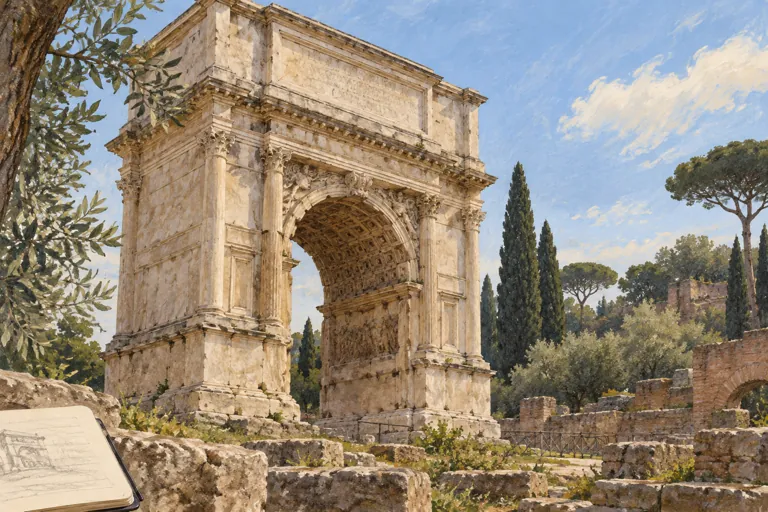
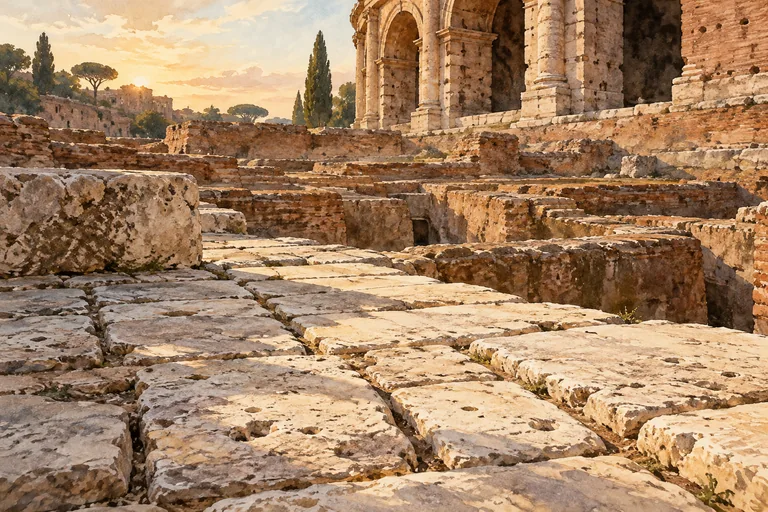
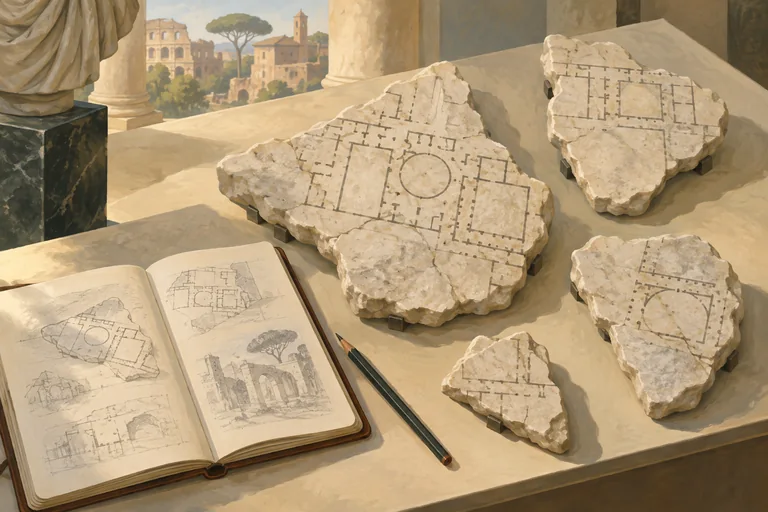
A first look at the Temple of Venus and Rome

The Temple of Venus and Rome is a rewarding place to slow down near a very famous neighbor. Its surviving brick curves and scattered architectural elements can seem less immediately readable than the Colosseum, but that is precisely the pleasure. Instead of receiving a complete building at a glance, you assemble an understanding from orientation, materials and the relationship between what survives and what is missing.
Start with one simple idea: this was a sanctuary with two principal spaces facing in opposite directions. Carry that fact into the visit and the ruins become easier to organize. You do not have to imagine every column standing or every surface gleaming to appreciate the scale of the architectural ambition.
Two dedications, two directions
The park’s official monument account identifies the deities as Venus Felix and Roma Aeterna. Construction began under Hadrian in AD 121 and was completed under Antoninus Pius in AD 141. The paired cellas, or principal sacred rooms, faced away from one another; the Venus side faced the Colosseum valley. This is a useful spatial starting point, rather than a reason to memorize a full sequence of imperial dates.
From an authorized viewing position, try making a very rough plan on paper: one rectangle, two opposing directions and a mark for your own position. Leave uncertain edges unfinished. A drawing that honestly records what you cannot establish is often more helpful than a polished sketch assembled from guesswork. Our Forum orientation guide uses a similar approach to turn a large archaeological site into understandable relationships.
The brick is only part of the story
The visible monument includes substantial changes associated with Maxentius after the fire of AD 307, including the apses and their coffered vaults. The park also describes colorful stone decoration and later restoration. Bare brick should therefore not be mistaken for a complete record of the original visual effect, nor should every surviving curve automatically be assigned to Hadrian’s first design.
That distinction changes how you look. Search for a junction, a surviving surface or a repeated recess, then ask what it contributes to your reading of the space. Is it showing structure, finish or repair? You do not need a confident answer for every piece. The exercise keeps a ruined building from becoming a generic backdrop and encourages attention to the evidence immediately in front of you.
Follow a material beyond one monument
The park’s itinerary on Egyptian connections highlights red porphyry in the Temple of Venus and Rome, the Temple of Romulus and the Basilica of Maxentius. It connects this prestigious stone with Egyptian quarries and points out its use in prominent architectural settings. A material can be a productive thread through a visit, joining places that otherwise appear to be isolated stops.
Use that thread carefully. A reddish stone spotted from a distance is not automatically porphyry, and a fragment lying nearby does not establish its original position. Ask a guide to identify a documented example. If color and craft interest you more than lists of rulers, say so before booking: an explanation shaped around materials may be much more satisfying than a rapid chronological survey.
Allow for the lives that followed antiquity
The park’s history of the Forum describes the reuse of ancient buildings as churches, including the relationship between this temple and Santa Maria Nova. Later use belongs to the history of the place. It helps explain why archaeological Rome should not be pictured as a city that simply stopped changing when the emperors disappeared.
Our account of the Colosseum’s changing life provides another example of that long perspective. Read it alongside our guide to deciding whether to add the Palatine if you are choosing how much archaeology to include in one day. Depth and distance are different measures of a good visit.
Plan around current access
Check the park’s current visitor information and the precise inclusions of your ticket or tour. Historical descriptions and old restoration news explain the monument but cannot guarantee that every terrace or path will be open on your date. Keep a nearby alternative in mind so a temporary restriction does not spoil the day.
Browse history experiences around the Colosseum and Forum when you want guided interpretation, and ask which monuments are actually discussed. Leave a short pause after the temple rather than immediately chasing the next view. Looking back at the space after understanding its two directions can be the moment when the fragments finally begin to fit together.
Sources & further reading
Turn a good read into a great day.
Find a highly rated Roman experience that brings these stories to life.
Explore related experiences →