What can the House of the Vestals teach you about archaeological evidence?

The House of the Vestals is a good place to learn one of archaeology’s most useful habits: separating what survives from what we think it means. Rooms, fragments and display arrangements do not all speak with the same certainty. A thoughtful visit can be less about memorising a complete ancient household and more about asking how specialists reach an interpretation, and why they sometimes revise it.
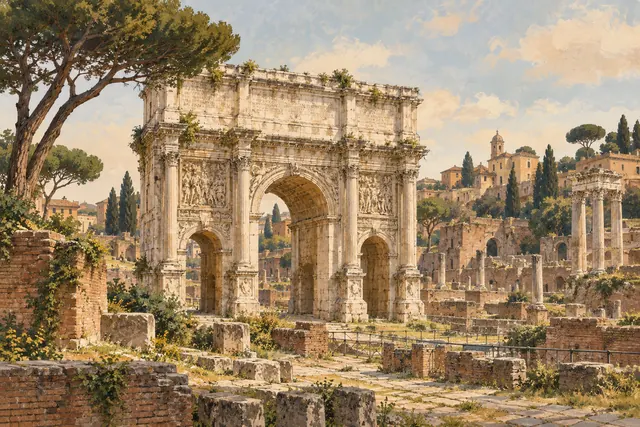
Known as the Atrium Vestae, the complex belongs to the Roman Forum. Treat it as a focused part of that larger visit. Our guide to understanding the Forum will help you establish the broader setting before concentrating on one group of rooms. You will enjoy the details more if you have already stopped trying to identify every ruin at once.
The place you see also has an excavation history
The archaeological park’s account of the House of the Vestals describes Rodolfo Lanciani’s excavations of 1882–1884. It also explains that objects were arranged after discovery, that some entered museum displays, and that recent restoration and investigation have informed the southeast sector. The remains therefore have more than an ancient date: they have a history of discovery, care and explanation.
That distinction changes how you look. When a fragment stands neatly in a space, ask whether the label identifies its findspot or its present display position. When masonry seems continuous, notice whether the interpretation describes several phases. A neat visitor route is helpful, but it should not persuade us that all the visible material was built together or has remained untouched since antiquity.
A millstone is an object; a working mill is an argument
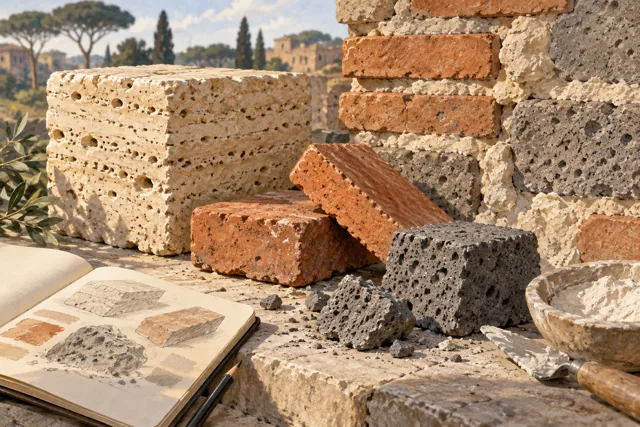
The park discusses a particularly useful example in Room D. Lava-stone mill fragments helped encourage an interpretation of the circular room as a mill. Its current explanation also describes construction-related reasons to question that conclusion and notes a likely early twentieth-century placement of a stone component. The lesson is not that archaeology cannot tell us anything. It is that different pieces of evidence must agree before a confident story is justified.
Try holding two ideas separately: an object may really be a millstone fragment, while the room’s exact function remains open to debate. This is an excellent conversation for a mixed-age group. Ask, “What can we observe?” and then, “What would we need to know next?” Those questions are often more interesting than racing to a final answer. They also make uncertainty feel like an invitation to investigate.
Read a room without furnishing it in your imagination
Begin with the boundaries that remain visible from the authorised path. Look at the relationship between openings, walls and neighboring spaces. Then read the explanation and see which of your observations it supports. Avoid assigning a bedroom, kitchen or store to every outline merely because a modern home needs those rooms. The habits and arrangements of an ancient institution need evidence of their own.
The same approach helps on Palatine Hill, where fragments and large spaces can invite very elaborate mental pictures. Imagination is enjoyable, but it works best when clearly identified as imagination. A sketch can distinguish surviving outlines from your own tentative ideas, using a solid line for one and a dotted line for the other.
Use the museum label as a conversation starter
Look for words such as “probably,” “interpreted” and “attributed.” They are useful information, not signs of a poor explanation. They tell you how firmly a conclusion is supported. Notice dates of excavation or restoration as well as ancient dates, and check whether the text describes the room itself, a portable object, or a practice known from written sources. These are related forms of evidence, but they are not interchangeable.
Our article on the Forma Urbis marble map offers another way to think about incomplete evidence. A surviving fragment can be tremendously informative without containing a complete answer. On a longer journey, the house layouts at Herculaneum provide a useful comparison, while retaining their own very different preservation history.
Plan access around the current arrangements
Use the park’s current visitor information to confirm which parts of the complex are accessible and what admission covers. Restoration, conservation and route management can affect what you see on a particular day. Our Forum admission guide explains the broader choices. Do not treat a photograph of an open room as a promise that every ticket includes it.
If you would like a guide to help connect the evidence, compare the history experiences and confirm the named stops. Leave enough room in your schedule to pause without obstructing others. One carefully considered room can give you a method for the rest of ancient Rome: observe, read, distinguish, and remain curious about the parts still being worked out.
Sources & further reading
Turn a good read into a great day.
Find a highly rated Roman experience that brings these stories to life.
Explore related experiences →