Rome’s Portico of Octavia: how can one entrance reveal a larger complex?

The Portico of Octavia is a good place to practise an archaeological habit: asking what is missing before deciding what a monument was. Its surviving entrance has enough columns and a pediment to suggest a self-contained building. Yet that impression can mislead. You are looking at part of the approach to a much larger complex. The useful question is not “Where is the rest of this façade?” alone, but “What kind of space did this entrance once organise?”
An entrance is not the whole plan
The municipal archaeological account describes an enclosed portico containing temples and other facilities. Augustus rebuilt the earlier Portico of Metellus and dedicated the new complex to his sister Octavia. Much of what survives visibly belongs to a later restoration under Septimius Severus, following fire damage. The name therefore does not give every stone the same date. A monument can retain an older identity while its fabric records subsequent work.
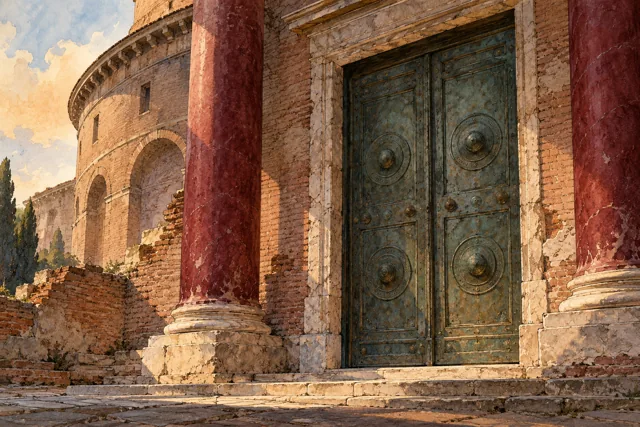
Keep that distinction in mind when looking at the main entrance. The surviving corner and monumental approach provide evidence for the complex, but they do not make its full layout obvious on the ground. Use an official plan, if one is available on site, to relate the fragment to the larger enclosure. Treat the plan as an interpretation supported by archaeological study, not as permission to imagine every absent wall at a confidently chosen height.
Look for the junction between materials
Begin with the columns and the horizontal stonework above them. Notice where an element ends, where a surface has weathered and where the rhythm is interrupted. Then look at the contrasting brick arch. The municipal account identifies this as a medieval replacement for two columns at the front. That interruption is valuable evidence of a later building problem and a later solution; it is not merely an unfortunate blemish on an otherwise perfect ancient composition.
You do not need specialist vocabulary to make a useful observation. “The brick curve meets an older straight stone member” is already more precise than “everything here is Roman.” If you want names for the shapes, add them after you have looked. Our guide to Roman building materials offers a practical starting point without turning a walk into an examination.
Read an inscription as a dated intervention
The restoration inscription is another reminder that an ancient building could announce a new chapter in its own life. It should not be treated as a timeless label placed there for modern tourists. Ask who was speaking, what work was being claimed and why a visitor approaching the entrance would encounter those words. You can appreciate that public function even if you cannot translate every surviving letter.
Our introduction to reading Roman inscriptions without Latin suggests ways to separate what you can see from what a translation supplies. Avoid tracing letters with your fingers or climbing to obtain a better photograph. Distance, a permitted viewing position and an official transcription are more helpful than physical proximity that damages the monument or puts you in danger.
Reuse belongs to the archaeological story
The later church of Sant’Angelo in Pescheria and the area’s fish-market history belong to the monument’s long afterlife. They help explain why a fragment of an ancient complex continued to matter in a changing city. Reuse does not necessarily preserve a building unchanged, but it can give particular walls and entrances continuing practical value. Look for the relationship between structures rather than sorting the view into a supposedly pure ancient part and an irrelevant later part.
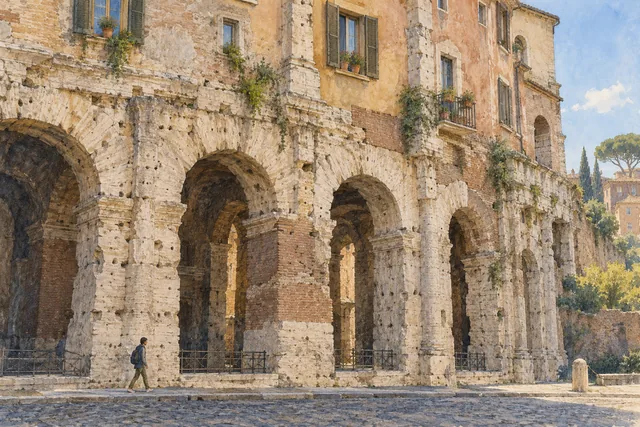
Nearby, the Theatre of Marcellus offers another example of architecture with successive lives. The two sites make a productive comparison because their forms and later uses differ. Do not assume that an apparent connection on a street map means a particular archaeological passage is open. Follow current barriers and signed public routes, and check notices when planning a guided visit.
Keep the surrounding neighbourhood in the picture
A focused archaeological stop need not take possession of the whole neighbourhood. People live, work, worship and remember here. For the wider context, read Rome Tour Hub’s guide to Jewish Rome around the Portico d’Ottavia. Its living-community and memory perspective complements this specialist reading of the surviving entrance; neither perspective substitutes for the other.
If you would like a guide, compare the stated routes in our archaeology and Rome experience collection. A Colosseum ticket does not automatically include every archaeological monument in the city, and a tour’s title should not be used to invent additional access. At the portico itself, a modest aim works well: identify one ancient element, one later intervention and one question the fragment cannot answer on its own.
Sources & further reading
Turn a good read into a great day.
Find a highly rated Roman experience that brings these stories to life.
Explore related experiences →