Rome’s Theatre of Marcellus: why is there a palace above the ancient arches?

The Theatre of Marcellus is a fine place to abandon the idea that an ancient building has only one correct appearance. Its curved arches belong to one story; the later building above belongs to another. Instead of mentally stripping away everything that followed Rome’s emperors, ask why the old structure continued to be useful. The answer changes a ruin from a stranded fragment into part of a city that kept adapting.
A theatre is not a smaller Colosseum
The municipal archaeological authority describes a Roman theatre with semicircular seating, rather than the enclosed oval arrangement of an amphitheatre. Julius Caesar began the project and Augustus continued it; the monument was dedicated in the name of Marcellus. The official account gives alternative dedication dates, 13 or 11 BC. Keeping that uncertainty is more accurate than choosing whichever date looks tidiest on a timeline.
Compare forms before comparing size. A theatre gathers an audience in relation to a stage; an amphitheatre arranges spectators around a central arena. The surviving curved exterior can make the two look superficially alike, but a shared architectural vocabulary does not make their plans interchangeable. Our guide to Colosseum seating provides a useful starting contrast without turning the two monuments into versions of the same attraction.
Read the join between the ancient and later buildings
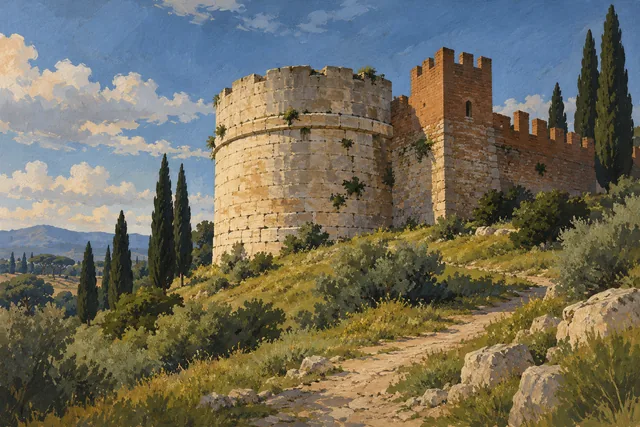
The official monument history records medieval fortification and a sixteenth-century palace designed by Baldassarre Peruzzi for the Savelli, later acquired by the Orsini. These are substantial changes of use, not simply repairs to a theatre. Looking up from the lower arcades, notice where the rhythm of openings changes. Different needs can produce different relationships between solid wall, window, access and privacy.
A good observation stays modest. You can identify a visible change in texture without assigning every patch an exact century. An altered opening might have more than one phase, and a clean-looking stone is not automatically modern. Archaeological study brings together records, construction evidence and comparison. Your walk can practise those habits by separating “I can see a joint here” from “I know exactly why it was made.”
What can the surviving arches tell you?
Start at a safe distance where several bays can be seen together. Follow the repeated pattern with your eye, then look for an interruption. Rhythm makes irregularities noticeable. A blocked opening or a change in surface becomes a question rather than an imperfection to edit out of a photograph. The result is a more attentive kind of sightseeing, with fewer names to memorise and more details to test.
Our introduction to Roman building materials can help with vocabulary. It is equally useful to sketch a few plain shapes on paper without claiming to reconstruct the missing building. Keep the sketch deliberately simple: an arch, a pier, a window above. If your drawing includes an imagined roof or an unseen staircase, label that as imagination rather than evidence.
The exterior is the visit
The authority’s practical information explicitly says the building is visible from outside. Do not expect an ordinary ticket to admit you to the palace above or to a complete ancient auditorium. A dated notice concerned closure of the archaeological area on 12–14 October 2026 for movement of large materials. That interval has passed at this article’s 20 October review, but it is a reason to recheck current notices and barriers, not a promise that every path is available.
Plan from the accessible public approach and obey any temporary signs. Avoid entering residential doors, following workers through gates or treating an open passage as automatic visitor permission. If an organised tour advertises a special interior, inspect the precise inclusion and current authorisation separately. An exterior-focused visit remains worthwhile without adding an access claim that the monument’s own page does not support.
Connect the monument to the living district
Reading reuse here pairs naturally with our discussion of layers at San Clemente, although the visit arrangements and evidence are different. For neighbourhood context beyond the ancient monument, Rome Tour Hub’s guide to Jewish Rome around the Portico d’Ottavia treats the surrounding district as a living community with its own history.
Leave enough time to make that transition thoughtfully. A neighbourhood is not an archaeological annex, and a resident’s window is not an invitation to photograph a private interior. If you want a guided continuation, our walking-tour collection lets you compare actual routes and meeting points. The Theatre of Marcellus rewards a particular kind of attention: seeing survival as a sequence of decisions, rather than expecting the city to have stopped at one ancient date.
Sources & further reading
Turn a good read into a great day.
Find a highly rated Roman experience that brings these stories to life.
Explore related experiences →