Rome’s Forum of Nerva: why do columns stand so close to a wall?

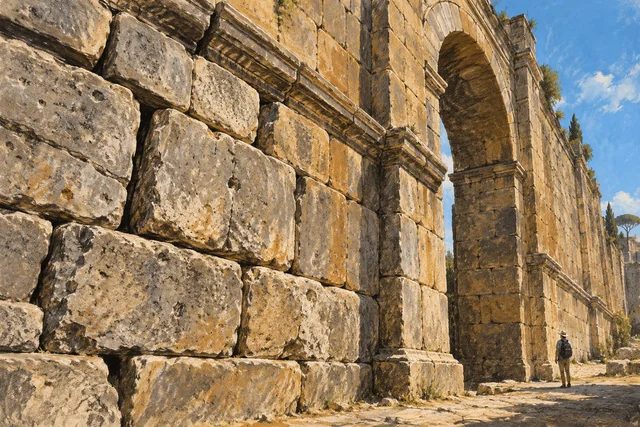
Columns usually invite us to imagine a generous space beneath a roof. At Rome’s Forum of Nerva, the surviving pair known as the Colonnacce suggests a more compressed solution. They stand close to a substantial wall, with projecting architectural members joining the two. That shallow gap is worth noticing. It opens a useful question about how monumental design responds when the available urban space is awkward rather than conveniently empty.
Put the narrow space back on the map
The Museum of the Imperial Fora explains that this forum occupied a restricted area between the Forums of Caesar and Augustus and the Temple of Peace. It also followed the line of the Argiletum, an important connection between the older Roman Forum and the Suburra. Instead of beginning with an isolated pair of columns, imagine a piece of city with neighbours and an established direction of movement.
A modern map can help you identify those neighbouring complexes, but it cannot restore every ancient experience of the route. Traffic, excavation and later building have changed the surroundings. Start with the broad relationship: a narrow site had to accommodate an architectural statement. Resist the temptation to draw a complete ancient street scene from the two surviving columns alone.
Notice the compromise without calling it a mistake
The museum describes the perimeter treatment as pseudoporticoes. There was insufficient space for full porticoes, so columns stood in front of the enclosure wall and were connected to it by projecting entablatures. The Colonnacce preserve part of this arrangement. Look at the relationship between vertical shaft, horizontal projection and wall before trying to identify every carved detail.
The prefix can sound dismissive, as though the design were a failed version of something better. A more productive question is what it accomplished within the constraints. Columns could create rhythm and relief across a boundary without requiring the depth of a conventional covered walkway. That is an interpretation of the documented arrangement, not evidence that an ancient visitor used our vocabulary of compromise.
Keep identification separate from close looking
Above the columns, a surviving female figure is traditionally identified as Minerva. The museum’s discussion of other fragments makes clear that female figures in the decorative programme should not all be assigned the same identity by appearance alone. Read the identification and its qualification carefully. A helmet or shield may be a useful clue, but a quick glance is not a substitute for specialist comparison.
You can still make detailed observations without settling an attribution. Which elements project most strongly? Where do shadows separate one architectural layer from another? Try describing the arrangement in ordinary words before using a technical term. Our Roman-inscriptions guide applies a similar discipline to lettering: notice what survives before completing what is missing.
Let the museum add evidence rather than replace the site
A visit to the Museum of the Imperial Fora at Trajan’s Markets can help connect excavated fragments with the larger decorative schemes. Museum displays may combine original pieces with supports or explanatory completions. Read the key and labels so that an effective display does not become, in your memory, a single intact ancient object.
The neighbouring Forum of Augustus offers a useful comparison in the handling of boundaries and constrained urban space. Keep the comparison specific: a wall, an opening or the placement of columns. You do not need to explain the whole imperial building programme to recognise that different sites answered different spatial problems.
Separate a public view from entry to the ruins
Seeing remains from a public street and entering an archaeological route are different visits. Consult the civic authority’s current Imperial Fora information for entrances, tickets and temporary restrictions. Its winter schedule, applying from 25 October through February, brings closing time forward to 16:30, with last admission an hour earlier. Allow for that earlier finish when organising an afternoon in late October.
Do not infer from the name of a Colosseum or Forum ticket that every nearby excavation or museum is included. Check the named areas and route. Compare archaeological history experiences on that basis, and leave enough time for standing still. Rome Tour Hub’s Testaccio neighbourhood article offers a complementary lesson in reading the city through its practical arrangements. At Nerva’s Forum, a small gap between column and wall can be the most revealing detail of the day.
Sources & further reading
Turn a good read into a great day.
Find a highly rated Roman experience that brings these stories to life.
Explore related experiences →