Monte Testaccio in Rome: how can broken jars document an economy?

An intact amphora looks like an object. A hillside made from broken amphorae asks you to think about a system. Monte Testaccio, in the ancient port area of Rome, preserves the accumulated consequences of moving, emptying and discarding containers. Its interest is not that rubbish somehow became picturesque. It is that repeated practical decisions left evidence on a scale large enough to change the landscape.
Begin with the container’s journey
The civic heritage authority describes a deliberately accumulated hill of pottery fragments, predominantly from amphorae used to transport oil from Baetica, in what is now Andalusia. Goods arrived through the nearby river-port and warehouse area. Once the contents were transferred, these containers presented a disposal problem. The hill therefore belongs to the history of supply and handling as much as to the history of ceramics.
Think through a simple sequence: a container is made, filled, transported, checked, emptied and discarded. Each step involves people, spaces and choices that a finished monument rarely makes so obvious. That sequence is a way of organising your questions, not a claim that every fragment reveals every stage. Archaeological interpretation depends on comparing many pieces and their contexts.
Distinguish a maker’s mark from a painted record
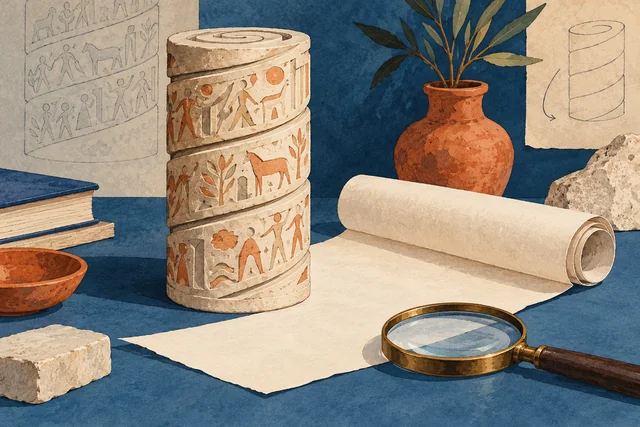
The official descriptions explain that some handles retain impressed marks, while other fragments preserve painted notes known as tituli picti. Such notes could record information about exporters, contents, checks and dates. A mark impressed in clay and a note applied later belong to different moments in a container’s life. Even without reading Latin, you can understand why that distinction matters.
Our Roman-inscriptions article suggests beginning with the physical form of writing before attempting a translation. Apply the same patience here. Do not assume that an isolated letter identifies an owner, or that every stain is writing. A guide or publication can explain how specialists distinguish meaningful records from damage, surface deposits and incomplete traces.
See organised disposal rather than a random heap
The authority describes systematic stacking and the use of lime, which helped address the effects of decomposing oil residues and contributed to the accumulation’s stability. This is an important shift in perspective. The hill records management of discarded material, not simply careless dumping outside a city that had stopped paying attention.
Ask what the scale implies without inventing a total. Repeated deliveries require storage and circulation; repeated disposal requires a place and a method. Exact quantities and trade shares are matters for specialist research. A visitor can understand the broader relationship between consumption and infrastructure without attaching an impressive but unsupported number to every view.
Treat access as a planned archaeological visit
Monte Testaccio is not an ordinary park hill available for an impromptu climb. The current civic page requires reservation through 060608. Accompanied groups may visit within the stated limit, while individual opportunities follow a specific reserved calendar. Check that calendar for your actual date. An old notice for an October excursion is not evidence that the same outing runs every October.
The authority also states that admission does not include the guided visit, which must be arranged separately. Confirm the total arrangement with the organiser: meeting place, guide, admission, duration and cancellation conditions. A neighbourhood food walk mentioning Testaccio does not automatically include entry onto the archaeological hill. Compare the named access carefully before assuming two offers describe the same experience.
Respect the terrain and the evidence underfoot
The official information warns that the site is not wheelchair accessible and has no toilets. Comfortable low shoes are recommended. Visitors must not approach edges or venture onto the slopes, and collecting ceramic fragments is prohibited. These rules protect both people and the evidence. A small sherd carried away as a souvenir is still part of an archaeological site.
If the terrain does not suit your party, keep the wider neighbourhood as a separate outing rather than promising an equivalent hill visit. The Pyramid of Cestius and Tomb of Eurysaces offer other ways to connect material form with Roman lives, though their locations and access arrangements differ. They are comparisons, not an instruction to add two distant stops to one walk.
Browse Roman history experiences for suitable guided options, then use Rome Tour Hub’s Testaccio neighbourhood guide for the area’s food and later working history. The specialist question remains with the pottery: what information did a useful container acquire before someone decided it was no longer useful? Monte Testaccio makes that final decision unexpectedly eloquent.
Sources & further reading
Turn a good read into a great day.
Find a highly rated Roman experience that brings these stories to life.
Explore related experiences →