Rome’s Forum of Augustus: what can its enormous boundary wall explain?

At the Forum of Augustus, it is tempting to give all your attention to columns and the remains of a temple. Try looking behind them. The huge wall toward the Suburra makes an unusually direct statement about the relationship between an imperial project and the city beside it. It enclosed a planned monumental space while confronting the practical problem of a crowded neighbourhood. A boundary can be a remarkable piece of architecture.
Begin with what is actually standing
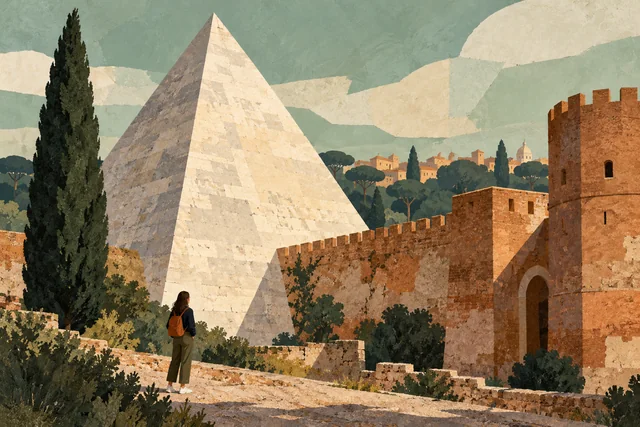
The civic heritage authority identifies blocks of peperino, Gabine stone and travertine in a wall reaching about thirty-three metres at its highest surviving stretch. You do not need to identify each stone by colour to understand the scale. Start with the size of the blocks, the courses that organise them and the height of an opening relative to a person. Those are observations you can make without reconstructing a vanished roof.
The same authority explains that the peperino and Gabine stone were considered fire-resistant. The wall helped separate the Forum from the Suburra, where timber structures contributed to frequent fires. Keep that documented function in mind, but do not turn the wall into a modern certified fire barrier. Ancient choices of materials belong to a different building culture and should be described in their own context.
An enclosure still needs connections
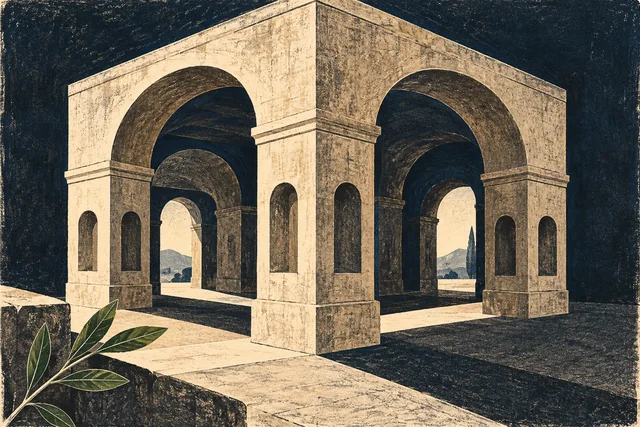
The wall contained two entrances from the Suburra: a triple opening on one side of the temple and a monumental travertine arch on the other. The latter became known in later centuries as the Arco dei Pantani. Notice the useful tension here. The Forum was set apart, yet people needed ways to move between it and the surrounding city. A boundary is not the same thing as total isolation.
A visible ancient opening is not automatically an authorised modern shortcut. Look from the public places currently available and obey barriers and route signs. The authority identifies views from Via dei Fori Imperiali and Via Alessandrina, with the rear seen along Via di Tor de’ Conti; current works or restrictions may alter the practical route. The purpose of the walk is to read the wall, not to insist on reaching every angle.
Place the wall within the larger project
The Forum of Augustus was one of several imperial additions to Rome’s civic centre. The official account connects the creation of another forum with the need for space to administer justice, as well as Augustus’s political and dynastic programme. This helps explain why a visitor should think beyond an isolated temple. A forum was an organised environment in which architecture, movement and public activity worked together.
Our Roman Forum introduction helps distinguish that older civic landscape from the Imperial Fora. Do not treat all visible ruins beside Via dei Fori Imperiali as one undifferentiated site or one guaranteed ticket inclusion. Names describe different complexes; admission arrangements describe the route you can actually take today.
Use a reconstruction as a question, not a photograph
A plan can help you understand how a surviving wall related to a much larger space. Check its key and whether a proposed element is marked as hypothetical. The official Forum page itself labels some reconstructed features with uncertainty. That is a strength of archaeological explanation: it tells you where evidence is firmer and where a model remains open to revision.
Compare the plan with one feature you can identify confidently, then work outward. Our Roman building-materials article offers another method for slowing down, while the Trajan’s Markets guide explains why a nearby museum visit can add context. A reconstruction is most useful when it sends your eyes back to surviving fabric.
Let the modern city remain in the picture
The wall is still part of a lived urban setting. Watch for traffic, keep pavements and entrances clear, and stop before raising a camera rather than walking backwards for a wider frame. A short, comfortable observation can be more productive than a long circuit attempted when you are already tired from the Colosseum. The monuments will not become clearer merely because you add more steps.
For a guided archaeological day, compare history experiences by their named sites and access. For the streets beyond the specialist ancient-city focus, Rome Tour Hub’s Testaccio neighbourhood article shows a different way to connect built form with urban life. At Augustus’s Forum, take away the same habit: ask what a structure separates, what it connects and which parts of that answer the evidence can support.
Sources & further reading
Turn a good read into a great day.
Find a highly rated Roman experience that brings these stories to life.
Explore related experiences →