Rome’s Forum of Caesar: how does a courtyard make a temple matter?

A temple can dominate a place without occupying most of its ground. At Rome’s Forum of Caesar, the relationship between an elongated square and the Temple of Venus Genetrix offers a useful way to understand that effect. Begin with the empty space rather than the surviving columns. Ask where a visitor’s attention is drawn, how the edges organise the view and what changes when a sacred building rises above the surrounding level.
Find the square before identifying every fragment
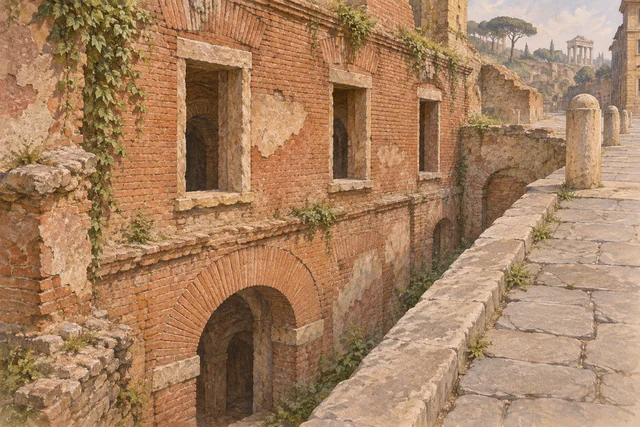
The Museum of the Imperial Fora describes a rectangular courtyard paved with travertine and flanked by double-aisled porticoes. The temple stood at the far end on a high podium. Those basic relationships are enough for a first reading. You do not need to reconstruct every roof and statue in your imagination before the design begins to make sense.
Use an official site plan to orient yourself, then compare its clear geometry with what can actually be seen. The excavated area is only part of the ancient whole, and modern streets interrupt the setting. A plan is helpful precisely because it is an interpretation assembled from evidence. It should clarify the surviving remains, not persuade you that every line on the page is equally visible on the ground.
Remember that the name does not date every stone
The University of Padua’s archaeological record places the inauguration in 46 BC and notes that work continued under Augustus. It also records major interventions under Trajan and restoration after the fire of AD 283. A complex called Caesar’s Forum therefore contains a longer building history than its name might suggest. Avoid assigning every surviving architectural feature to one famous patron.
This is a useful habit throughout Rome. A monument’s identifying name tells you how to find it, but it may compress centuries of change. When you read a label, look for the phase as carefully as the object type. A column, relief or wall can help explain a later use of an older setting, and that later story is not less interesting because Caesar did not personally see it.
Notice how height and approach work together
The museum’s account states that access to the temple podium was by steps along its sides, rather than a staircase directly across the front. That detail complicates the simple picture of a straight ceremonial march up the middle. The building could establish a strong visual focus without making the line of sight identical to the route of approach.
From a permitted viewpoint, distinguish what you can observe from what the archaeological account supplies. You may be able to recognise the raised mass or the alignment of the space while needing a plan to understand circulation. There is no need to climb, cross barriers or search for a better angle from a restricted area. The question is how the arrangement worked, not how close you can get to every surface.
Let the museum change the scale of the visit
The Forum of Caesar section at the Mercati di Traiano displays architectural fragments associated with different phases of the complex. Its account distinguishes the relatively rare early material from decoration belonging to the Trajanic rebuilding of the Temple of Venus Genetrix. Looking at these pieces close up can provide information that is difficult to recover from the distant archaeological view.
Concentrate on one fragment’s original job. Did it belong to a column, a projecting cornice or a wall decoration? A carved surface once had neighbours and a position in a larger arrangement. Recomposition helps explain those relationships, but read which parts are original and which are additions. A convincing museum assembly is not the same thing as an ancient structure surviving intact.
Keep three kinds of access separate
A street-level view, admission to the archaeological visitor route and entry to the museum are different outings. Check what the ticket you select actually covers. The municipal Imperial Fora page describes a controlled route beginning near Trajan’s Column and passing through parts of the ancient complexes; it should not be read as unrestricted access to every visible ruin.
For the winter period beginning 25 October, the published archaeological hours are 09:00–16:30, with last entry an hour before closing. Confirm the current notices and ticket rules for your date. Late-afternoon arrival leaves little room for orientation or an unexpected delay. Museum hours and entry conditions need their own check, even when you intend to combine both visits.
Our Forum of Nerva article explores a very different response to limited space; the Forum of Augustus offers another monumental comparison. The Trajan’s Markets guide helps place the museum within its setting. Browse archaeological experiences by the sites explicitly included. For a later Roman use of architectural display, see Rome Tour Hub’s Casino Nobile guide. A courtyard becomes more interesting once its apparently empty centre starts doing some historical work.
Sources & further reading
Turn a good read into a great day.
Find a highly rated Roman experience that brings these stories to life.
Explore related experiences →