The Meta Sudans: where was the fountain beside Rome’s Colosseum?

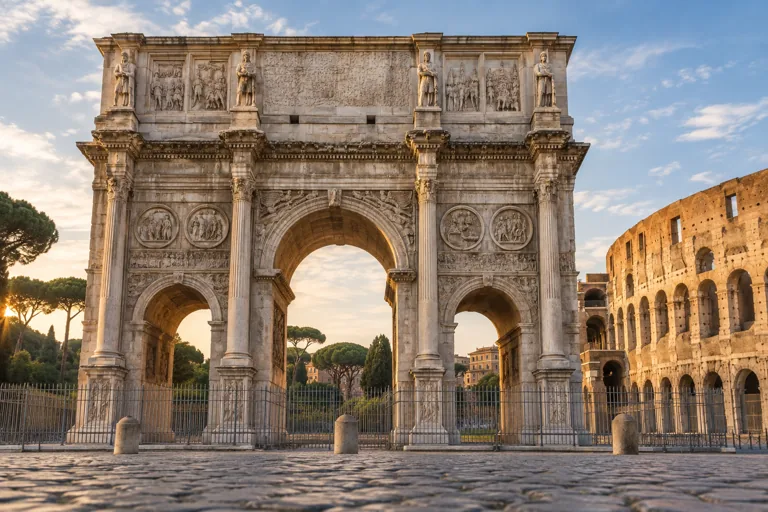
Between the Colosseum and the Arch of Constantine is an ancient monument that is unusually easy to miss. Look for the low circular footprint of the Meta Sudans. A monumental fountain once occupied this space. It was still a substantial ruin when early photographers recorded it, and its final demolition belongs to the twentieth century. Three kinds of evidence let you see more than the stones now offer. Start with the footprint, borrow the elevation from an old image and use the ancient street plan to put the fountain back into the city.
Where to stand and what to look for
Give yourself a minute before aiming your camera upwards. Almost everything worth photographing here seems tall. The amphitheatre fills one side of a frame and the arch supplies another obvious subject. The fountain asks you to look down between them. Use the park's account of the arch and Meta Sudans to identify the remains from a public viewing position. Its pairing of the monuments is handy for orientation. It does not make them part of one building campaign. The fountain belongs to the Flavian period, centuries before Constantine's arch.
To remember its shape, put a circle next to the fountain in your notes. Leave enough room above the circle for a cone. The lower structure was cylindrical and faced with marble. The tapering element gave the fountain its distinctive silhouette. The Latin name evokes a turning marker and a surface that sweats. Think of water moving over the object as well as of water collecting at its base. A fountain can make a junction legible without having to shoot a theatrical jet into the sky.
How much can a coin prove?
Ancient coin images help recover the shape that the surviving footprint has lost. A coin designer had to make the place recognisable in a tiny field. A rectangle with arches could suggest an amphitheatre, and a taper beside it could distinguish a fountain. The resulting image is strong evidence for a recognisable profile and association. It is less useful if the question concerns an exact measurement, the texture of a marble surface or the colour a visitor saw at noon.
Now try an old photograph. It can record the standing masonry in much greater detail. But its subject is the ruin that survived to the photographer's lifetime, long after water stopped running down its sides. A missing facing will not put itself back because a camera is accurate. Drawings made before the demolition add another record of the structure's condition. The park uses these sources together and still leaves room for more than one possible treatment at the summit. “Flower or sphere” makes a conscientious answer when no surviving stone settles the matter.
If you like this kind of comparison, the Forma Urbis guide looks at a different way Romans turned a city into an image, while the short reading of Constantine's arch shows why stone figures on the adjacent structure need their own chronology. Each medium favours particular questions. A coin excels at making two monuments neighbours. A fragment of a ground plan can make the width of the space between them newly interesting.
A fountain with an older address
The city's account locates the fountain at a meeting point of streets and urban districts. Archaeological work has also identified a smaller fountain of the Augustan period in this area. For the Flavians, putting a new monument here meant working with an existing urban memory. Picture two maps drawn on tracing paper, one for Augustus and one for the emperors who built the Colosseum. If you pin the sheets at the fountain site, other things around the pin can shift while that particular junction keeps its significance.
Modern roadbuilding changed the picture yet again. It is easy to assume a Roman ruin this low was gradually worn away over fifteen centuries. The documented demolition for the road in the Fascist period gives the missing height a much more precise explanation. The story of the amphitheatre's changing neighbourhood puts that relatively recent intervention into a larger sequence.
Leave room for the fountain if you are planning a short Colosseum-area visit. Two minutes looking for the monument that isn't tall will change the photograph you eventually take. Frame a little ground below the arch and amphitheatre, and the space between them becomes a subject in its own right.
Sources & further reading
Turn a good read into a great day.
Find a highly rated Roman experience that brings these stories to life.
Explore related experiences →