Rome’s Via Latina tombs: what can you see on the park’s virtual visit?

The best place to begin a visit to Rome's Tombs of the Via Latina may be a screen. The Appia Archaeological Park announced a temporary closure of the area for works starting on 22 June 2026 and directs visitors to its virtual tour. Check the current park notice before travelling. The model and photographs are particularly good company for a monument whose finest surfaces are overhead. The ancient road, the rooms beneath it and the raised white decoration on one ceiling call for three different ways of looking.
Start at street level
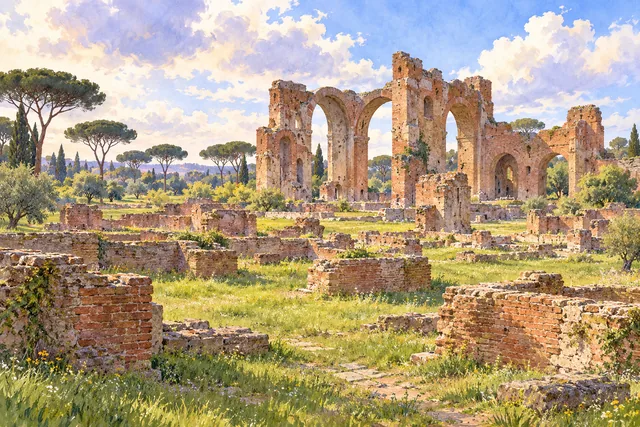
A traveller along a Roman road encountered the living and the dead on the same journey. Tombs addressed people passing along the road. Buildings for work and refreshment could occupy neighbouring plots. On the Via Latina a surviving stretch of the route gives the different buildings a common reference line. In an aerial photograph, follow the road with your finger before trying to match each named tomb to a picture. A monument described as “along the Via Latina” is easier to place once the road is something more than an address.
Tempting as it is to imagine a quiet park reserved entirely for commemoration, the archaeological evidence gives a more crowded picture. The park's report on work near the tombs describes rooms interpreted in connection with stopping travellers, including shops and bathing facilities. A different identification can depend on surprisingly modest traces. Water pipes, heating elements or a geometric floor say things that a rectangular outline alone cannot tell you. If you enjoy asking which detail makes a room intelligible, compare the much grander Baths of Caracalla.
Turn towards the vault
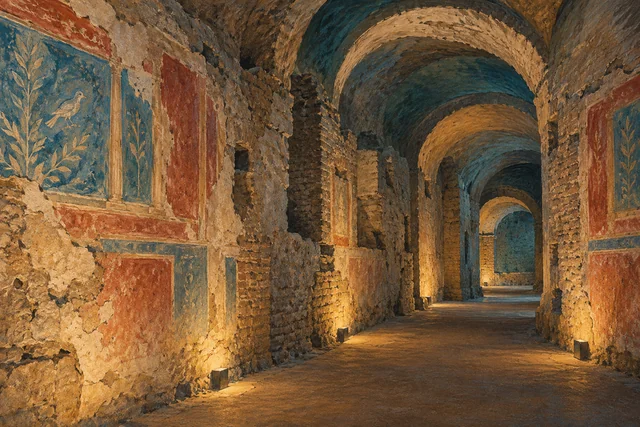
Look up virtually inside the Tomb of the Valerii. The small figures on its vault are worked in stucco. Where a painter can change colour to make one shape stand out, raised modelling makes tiny shadows do some of the work. Pick a single figure and cover the decoration around it with your fingers on the screen. Which edge is visible because of a shadow? Which one because a line was deliberately emphasised? Enlarging the image briefly is useful. Then back out until you can see how much repeated framing surrounds the detail. Both scales belong to the composition.
Now compare the Tomb of the Pancratii. Here painted areas and relief share the job of organising a chamber, and a large marble sarcophagus gives the floor a visual weight of its own. A ceiling photograph can make an underground room seem limitless because nothing in the picture anchors it to human scale. Include the sarcophagus in a second view and the room becomes a place where bodies were received and remembered. Decorations that look like a pattern book in isolation regain a setting quite unlike that of a dining room or a public bath.
What a conservation notice actually tells you
A dated notice has greater bearing on a planned outing than a general price or booking panel lower on the same website. The park links the temporary closure with work at the entrance and on the tombs, and says reopening will be announced through its own channels. Do not build a journey around a ticket button while the closure notice remains current. Use the virtual visit in the meantime. A park-wide visitor information page is a useful second check because it distinguishes these works from access at other monuments.
For a future in-person outing, look up the Via dell'Arco di Travertino entrance specifically. A generic search for the Appian Way can place you on a different ancient road. If a companion wants a long walk while you want tomb architecture, compare the scale of a half-day on the Appian Way with the concentrated view offered by a single site. The tomb of Caecilia Metella makes a good contrast. Its great cylindrical exterior announces itself at a distance, whereas some of the most eloquent details of the Via Latina disappear below the modern visitor's feet.
Before choosing an archaeological history experience, identify which road and monument it names. Then take a small question into the virtual or eventual physical visit. Ask one person to pick the strongest sign that the road served travellers and another to pick a detail made for the people commemorated here. The two answers can come from neighbouring buildings. That closeness makes the Via Latina more revealing than a row of isolated photographs of Roman tombs.
Sources & further reading
Turn a good read into a great day.
Find a highly rated Roman experience that brings these stories to life.
Explore related experiences →