Rome’s Domus Aurea: how does an underground visit differ from an open-air ruin?

The Domus Aurea asks for a different kind of preparation from a walk through open-air Roman ruins. You are entering a surviving part of an imperial complex beneath later layers of the city, where conservation conditions and managed access shape the experience. Treat it as its own appointment, with its own ticket and practical requirements. Being geographically close to the Colosseum does not make the two visits interchangeable.
Understand what survives underground
The archaeological park describes Nero’s residence after the fire of AD 64 as a much broader complex of buildings, gardens and other landscape elements. The portion visited today on the Oppian Hill is only part of that story. Later construction and the filling of rooms helped turn spaces once associated with imperial display into an underground archaeological environment.
That change of context is essential to how you look. The darkness and surrounding mass you experience now should not be projected automatically into the original use of every room. Equally, a polished digital reconstruction, if included in your chosen visit, is an interpretation designed to help explain lost relationships. Keep surviving fabric, scholarly interpretation and present-day presentation distinct in your mind.
Read the actual calendar, not just the monument name
The park’s main page checked on 29 October 2026 lists ordinary opening on Friday, Saturday and Sunday, from 09:15 to 17:15. The available booking calendar and current notices determine the visit you can actually reserve. A separate 2026 Highlights programme offers selected third-Thursday appointments; it should not be mistaken for general opening every Thursday or for the same product as an ordinary visit.
Before committing, compare the date, language, start time, duration and meeting instructions shown for your chosen option. Look for the precise inclusions, including whether interpretation is guided and whether any multimedia element is part of that particular offer. A familiar site name in two listings can conceal different arrangements. Save the confirmation instructions somewhere you can read them without relying on a perfect mobile connection at the entrance.
Dress for the interior rather than the weather outside
A conservation dossier published by the park describes temperatures around 10–12°C and very high humidity in the monument. That technical description explains why an underground visit can feel different from the sunny street above; it is not a replacement for current visitor advice or a guarantee of an exact temperature on your day. Bring a suitable layer and wear footwear appropriate to an archaeological visit.
If steps, surfaces, confined spaces or standing time affect your plans, ask about the specific route before booking. Do not infer suitability from a photograph of one wide corridor. A route may have constraints that are not obvious in promotional images. The most useful question is concrete: describe the aspect of access you need clarified and ask the operator what the booked visit involves.
Let the surviving surface set your pace
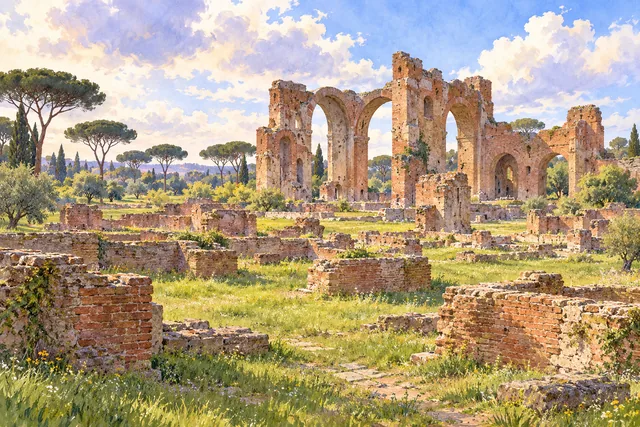
In an open-air site, the skyline and the distance between buildings help establish scale. Underground, walls, vaults and fragments of decoration often carry more of that work. Notice where colour survives, where a surface is interrupted and how the interpretation distinguishes phases. You do not need to identify every motif to recognise that the room has a material history beyond its most famous owner.
The park recounts the later rediscovery of these buried spaces and their importance for artists exploring what they understood as grotto-like environments. This helps explain the term grotesque decoration, but it does not make every painted fragment a complete Renaissance sourcebook. Ask how a particular surviving detail was recorded and interpreted. The most convincing story remains connected to something you can actually examine from the permitted route.
Give the rest of the day breathing room
Avoid placing another timed entry immediately after the expected finish. Leave room for the approach, check-in and an unhurried return to street level. Consult our Palatine Museum guide for a different indoor archaeological setting, Roman Forum orientation guide for open-air context, and Roman mosaic guide for surface-focused looking. Browse archaeological experiences by their actual inclusions. Rome’s Palazzo Massimo guide offers another encounter with ancient painted interiors. None of these comparisons changes the central practical point: book and prepare for the Domus Aurea as a distinct visit.
Sources & further reading
Turn a good read into a great day.
Find a highly rated Roman experience that brings these stories to life.
Explore related experiences →