Rome’s Temple of Saturn: what were its sacred and civic roles?

At the Temple of Saturn, the Roman Forum presents an idea that can feel unfamiliar to a modern visitor: a sacred building could also hold the state treasury. Religion, public authority and collective resources were not necessarily assigned the separate architectural boxes we might expect today. The surviving columns are therefore more than an attractive final photograph. They invite a question about how a city expressed trust and power in a shared public place.
The archaeological park identifies the temple with the Aerarium, Rome’s state treasury. Its historical interpretation of the monument also points to the restoration inscription left after a fire. These facts give you two different timescales to consider: the long institutional life of the sacred site and the later work that shaped the remains you see. They should not be collapsed into one supposedly untouched original building.
A temple can have more than one public role
It helps to put aside the assumption that every ancient building had one tidy modern equivalent. Calling this a temple tells you something essential, but it does not exhaust the building’s role in the city. The park’s themed account of the Forum connects Saturn’s sanctuary with the treasury and the display of public documents and laws. Sacred architecture and civic business occupied the same urban landscape.
That does not mean we can translate the site directly into a modern bank, ministry or archive. Each comparison reveals one aspect while concealing others. A better visitor’s question is: what kinds of authority were made visible here? Try holding the religious and administrative roles together, rather than treating one as a surprising exception to the other. The monument becomes more interesting when it resists a single label.
Read the position before the details
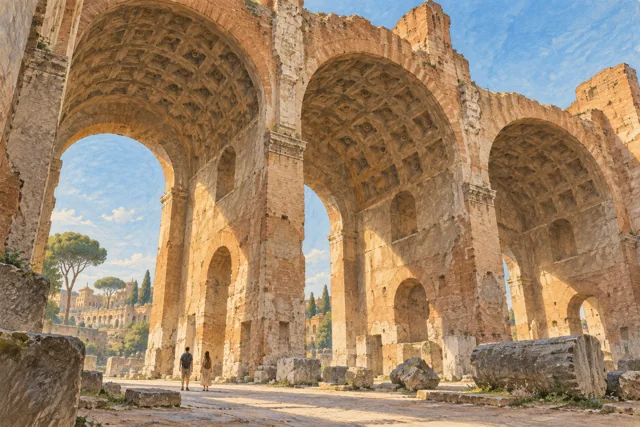
Begin with the temple’s position near the Capitoline end of the Forum. From an authorized viewpoint, notice how the columns relate to the changing ground level, neighboring ruins and routes through the valley. You are looking at a setting in which buildings addressed one another across public space. Our first guide to the Forum explains why location can be a more useful starting point than memorizing names.
Choose one relationship to sketch or describe. Perhaps the vertical columns contrast with a low wall, or the monument frames a patch of sky above a busy archaeological scene. Keep the exercise observational. Being able to see two monuments together today does not prove that every ancient visitor experienced the same view, level or route. The modern archaeological landscape has its own history of excavation and presentation.
Give the inscription a job
You do not need fluent Latin to recognize that a public inscription communicates an official message. At Saturn’s temple, the restoration record makes repair itself part of the monument’s public identity. Before attempting a translation, consider placement and legibility: where is the writing, how does it sit above the columns, and what sort of distance separates it from someone walking below?
Our article on reading Roman inscriptions without knowing Latin offers a practical method. Record only what you can actually see, use a reliable transcription when needed and distinguish an abbreviated name from your guess about it. A photograph taken from a respectful distance can become a useful reminder later. There is no reward for pretending to decipher a letter that the light will not let you read.
Keep the human scale in the walk
The treasury question can make a family visit lively. Ask what a community would want to protect, how people would know where public authority resided, and why a building might need to announce that it had been restored. These are discussion prompts, not evidence for a particular ancient ceremony. Let the answers lead back to the visible monument and the information supplied by the site.
Combine this stop with the nearby Arch of Septimius Severus to compare two forms of public statement. When choosing a Forum walking tour, ask whether the guide discusses civic life as well as emperors and battles. For a different kind of Roman public message, Rome Tour Hub’s Ara Pacis guide extends the theme beyond this valley. A short, attentive stop at Saturn’s columns can change how you read the rest of the city.
Sources & further reading
Turn a good read into a great day.
Find a highly rated Roman experience that brings these stories to life.
Explore related experiences →