Rome’s Basilica Aemilia: how do fragments suggest a public building?

The Basilica Aemilia asks a visitor to work with less than a complete building. A carved fragment, a stretch of foundation and a museum relief cannot restore the entire place to view. They can, however, make a remarkably good lesson in how archaeological knowledge is assembled. Begin with what is physically present, then use official interpretation to understand what has been identified, moved, repaired or reconstructed.
First, separate a civil basilica from a church
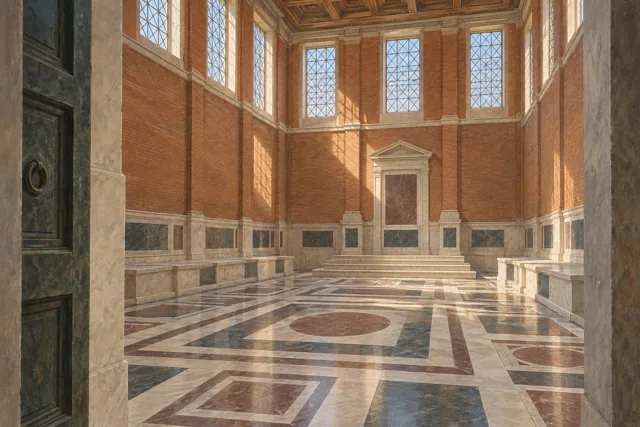
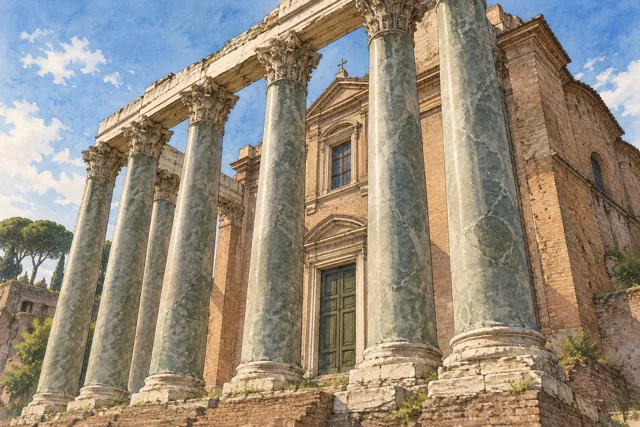
In the Roman Forum, the word basilica describes a type of large public building associated with civic and commercial life, rather than necessarily a Christian place of worship. The park’s introduction to the Forum’s public buildings discusses spaces used for business and the administration of justice. Knowing that helps you ask what a roofed, organized interior could contribute beside an open square.
Imagine the practical contrast without inventing an exact scene: shade or shelter, defined circulation and places for people to gather. The surviving evidence will not tell you what every individual said on a particular afternoon. It does let you consider why a city would invest in a substantial building next to a busy civic space.
Let rebuilding complicate the date
The archaeological park’s conservation account for the Basilica Aemilia traces its foundation to 179 BC and describes later rebuilding, including the consequences of a fire in 14 BC. Much of the architectural decoration now surviving belongs to its Augustan phase. One founding date therefore cannot label every piece you see.
This is a useful habit to carry through the Forum. Ask whether a date refers to the institution, an initial structure, a major rebuilding or a surviving component. Our guide to Roman building materials explains why visible differences deserve attention without becoming instant proof of a chronology. A color change may have several explanations; interpretation needs more than a quick glance.
Look at one fragment as an object
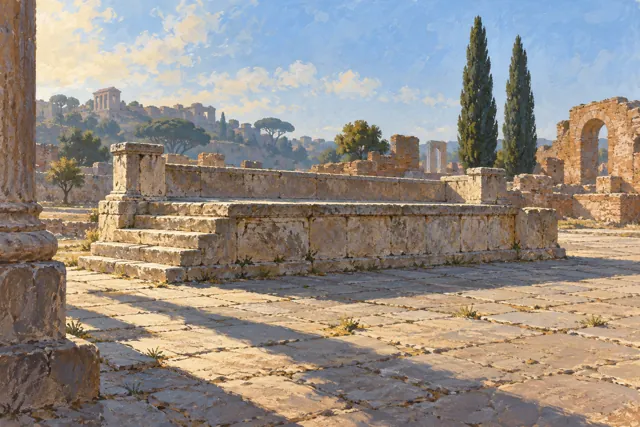
Choose a piece visible from the authorized path. Start with its profile: straight, curved, projecting or recessed. Then notice the relationship between carved decoration and the underlying mass of stone. Could the ornament have helped organize a larger surface? Is the broken edge revealing a thickness that would be hard to appreciate on an intact building?
Avoid turning this into a touching exercise. Weathered stone and conservation materials are not there to be tested by visitors. A photograph, sketch or brief written description is enough. If you sketch, leave uncertain edges incomplete. Drawing a neat but invented outline can make a possibility feel more definite than the evidence supports.
Remember that the display has a history too
The park’s conservation article explains that architectural elements were recomposed along the northern side during twentieth-century work and that casts were used for parts of the figured frieze. A visible arrangement is therefore not automatically an untouched ancient survival. That does not make it uninteresting: it adds another layer, showing how scholars and conservators have made fragments understandable.
Keep three questions separate. What is ancient material? What is a replacement or cast? What does the present arrangement suggest about the original building? You may not answer all three at every stop. Recognizing where you need the label, a plan or a guide is part of learning to read ruins responsibly, not a failure of imagination.
Follow the reliefs into the museum story
The Forum Museum’s official presentation includes reliefs from the basilica within its account of Rome’s origins and foundation narratives. Carved scenes can supply details absent from a broken architectural outline, but they are images with subjects and purposes, not transparent photographs of daily life. Read the museum’s identifications before naming an unfamiliar figure or episode.
Check current museum access and your ticket’s inclusions rather than assuming that every room mentioned in an online article is open on your chosen date. Our Palatine Museum guide considers the broader value of moving between objects and sites. The two settings offer different evidence, and each can sharpen what you notice in the other.
Make it one focused stop in the Forum
Use our Forum orientation guide to keep the surrounding buildings in view. If you are comparing public institutions, the Curia Julia article provides a distinct example of a meeting space. Resist making every building perform the same civic role merely because they stand near one another.
For guided options, inspect the named stops and admission details in our archaeological experience collection. A later visit to Palazzo Altemps can extend the question of how ancient material reaches a modern display. At the basilica, a satisfying result is modest and precise: one fragment understood better, one rebuilding distinguished, and one uncertainty honestly retained.
Sources & further reading
Turn a good read into a great day.
Find a highly rated Roman experience that brings these stories to life.
Explore related experiences →