Rome’s Nymphaeum of Egeria: why build a grotto in the Caffarella Valley?

At the Nymphaeum of Egeria in Rome's Caffarella Valley, the first thing to question is the name on the map. Antiquarians associated the ruin with the nymph who advised the legendary king Numa. The park's archaeologists identify the surviving brick structure as a second-century feature of the estate of Herodes Atticus. The two accounts belong to different histories. One explains why the spot has such an appealing name. The other helps explain why a wealthy household wanted an artificial grotto in this particular valley.
Let the valley set the scale
The park's description of the Caffarella places the estate in a wider landscape of the river Almone, waterworks, tombs and later buildings. A photograph that crops the monument to its vaulted opening can make it seem like a self-contained shrine. Pull back mentally and ask how an approach across open ground changes the experience of arriving at shade. A person coming to a summer meal would have registered temperature, sound and the sudden change in light before worrying about the architectural vocabulary. This is a place where it helps to put the landscape back into the room.
That does not mean every patch of present-day grass, every tree or every trickle of water is ancient scenery. Several centuries of farming and other uses intervene between the Roman estate and the park enjoyed today. Treat the hills and the valley as a frame for thinking about movement. Let the masonry answer more particular questions about the space once someone arrived. If you are planning to combine sites, the Appian Way day-planning guide explains why a few well-chosen stops make a better outing than a necklace of points far apart on a map.
How to make a cave on purpose
The ancient word behind nymphaeum can sound imposing. In this case, picture a deliberately built place of shade and water that evoked a natural grotto. The official site account identifies a barrel-vaulted room, smaller niches along its long sides and a larger recess at the far end. A reclining marble figure occupied the end niche. A river deity is a plausible identification. Naming it specifically as the Almone is a suggestion, not a caption left on the statue for later visitors.
Try looking first at the geometrical rhythm. Three recesses on one long wall create expectations about the opposite wall. A larger opening at the end gives the eye somewhere to stop. Now think about water reaching that same composition. A stone recess holds steady while the reflections in it change. Plants and damp surfaces can soften a hard outline. The designer could therefore evoke something naturally irregular within a space that was quite strictly ordered. This is a more interesting trick than simply making a room look old or picturesque.
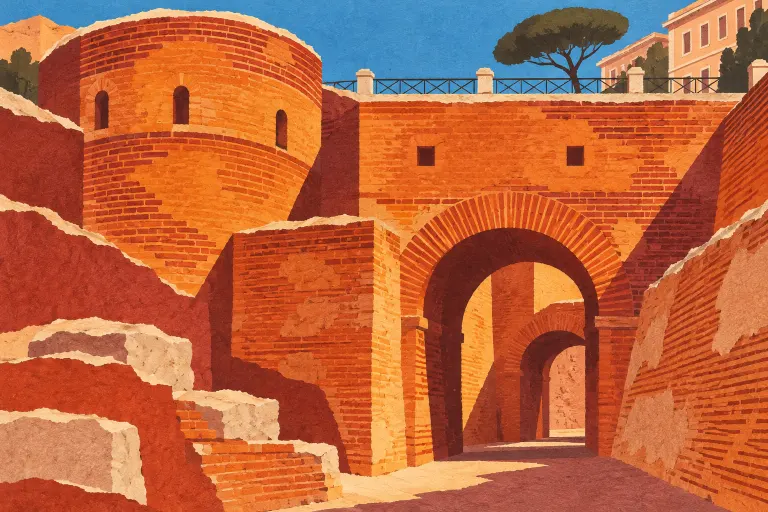
It is also worth asking what is missing from the brown brick view we recognise as archaeological. A room for leisure had finishes and visual effects the surviving structure can suggest only in part. The park's account and published archaeological references separate the supporting shell from its decoration. The same distinction helps at the Villa of the Quintili, where a visitor must reconnect much larger fragments with the activities of a suburban estate. No single imagined banquet, menu or guest list needs to be invented to make either place intelligible.
Where the nymph went
Sixteenth-century scholars associated the valley monument with the story of Egeria and Numa. The ancient sacred spring and grove are instead sought near Porta Capena, at the beginning of the Appian Way. On a modern map mark Porta Capena and the Caffarella in two different colours. That small act breaks the spell of a name that has been repeated for centuries. It also produces a good question to bring to other sites. Does the name identify an excavated building, a documented owner, a local tradition or someone's earlier guess? Rome's so-called Temple of Minerva Medica offers an equally instructive naming problem.
Check the park's current routes before setting out and remain on the paths indicated on site. Wear shoes suited to a valley walk, and build the outing around the landscape as well as the ruin. If comparing walking experiences, read the named route before assuming that a general Appian Way excursion reaches this part of the Caffarella. The most satisfying moment here is simple. After seeing what Roman builders did to make masonry feel like a sheltered cave, you can return to the real open valley and feel the difference yourself.
Sources & further reading
Turn a good read into a great day.
Find a highly rated Roman experience that brings these stories to life.
Explore related experiences →