What can you see around the Colosseum in two hours?
Two hours can be enough for a satisfying encounter with the Colosseum area, provided you make one important choice: spend the time on a booked interior visit, or use it for an exterior walk with a few carefully chosen stops. Trying to combine a full guided visit, the Roman Forum, Palatine Hill, and lunch makes the clock the main attraction.
Treat the following timings as planning allowances rather than measured walking guarantees. Crowds, road crossings, uneven surfaces, security procedures, and different walking speeds can all change the arithmetic. If the two-hour window ends with a train, flight, or another essential appointment, include the journey away from the area in your calculation before choosing an activity.
Option one: make the interior the whole event
If entering the Colosseum is the reason you came, choose a product that fits your available window, including check-in and any required arrival buffer. Read the stated duration carefully. A tour whose title names several monuments may require substantially more time than a simple admission visit. Also establish where it finishes; a route ending in another part of the archaeological area can affect your onward journey.
Do not interpret a reserved ticket as exemption from security procedures. The useful comparison is between the actual experience described by different products, not between increasingly energetic versions of the phrase “skip the line.” Our arena and underground explainer can help you identify which access matters to you before you book.
Once inside, spend the first moments understanding the whole space. Then choose a small number of details to study. You will get more from a short visit by looking purposefully than by constantly checking whether you have reached the next photograph. Follow the route and visit conditions attached to your ticket, and keep your departure buffer intact.
Option two: an exterior circuit with context
Begin at a safe pedestrian viewpoint where you can see the amphitheatre's overall curve. Walk only as far around it as your time and the current pedestrian arrangements comfortably allow. Compare the repeated arches with the interrupted outline of the surviving structure. The outside already offers a rich lesson in scale, rhythm, and the complicated survival of ancient buildings.
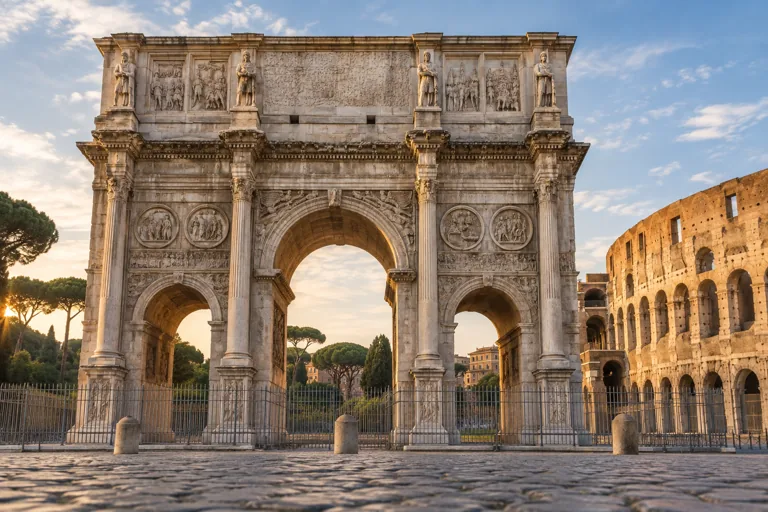
Give the Arch of Constantine its own pause. The official park description identifies it as a monument dedicated in 315 CE and explains its reuse of reliefs from earlier imperial periods. Our fifteen-minute looking guide turns that useful fact into a simple visual exercise. Stay outside barriers and do not expect access through every part of the monument.
If you still have comfortable time, choose one additional direction: the edge of the Forum along the public streets, or the Ludus Magnus area on the other side of the Colosseum. These are alternatives, not a compulsory sequence. Looking into an archaeological area from outside does not mean entering it, and sightlines can change with works and crowd management.
Keep the final half hour flexible
A short visit benefits from an unassigned ending. You might use it for a drink, a second photograph, a slower walk to the station, or simply a bench where available. If you have already spent most of your allowance, this is the time to leave, not to add a last attraction because it looks close on the map.
For a snack, pick somewhere whose ordering process you understand and whose prices are clear. A sit-down lunch can easily expand beyond a short gap, especially if the restaurant is busy. The lunch guide explains how to choose between a quick bite and a longer meal without treating either as an inferior experience.
What should you book?
Book when the interior, a guide, or a particular access area is central to your visit. For a flexible exterior walk, you may prefer to leave the time unbooked. A short guided walk can still be valuable if you want historical interpretation, but confirm that its route and ending suit your schedule. Check mobility requirements as carefully as the list of highlights.
Use Short Visits to compare relevant experiences. Favor a clear duration and meeting point over a long list of included sights. The most memorable two hours are often the ones with a little unused space: enough time to stand still, notice something unexpected, and leave knowing exactly why you want to return.
Sources & further reading
Turn a good read into a great day.
Find a highly rated Roman experience that brings these stories to life.
Explore related experiences →